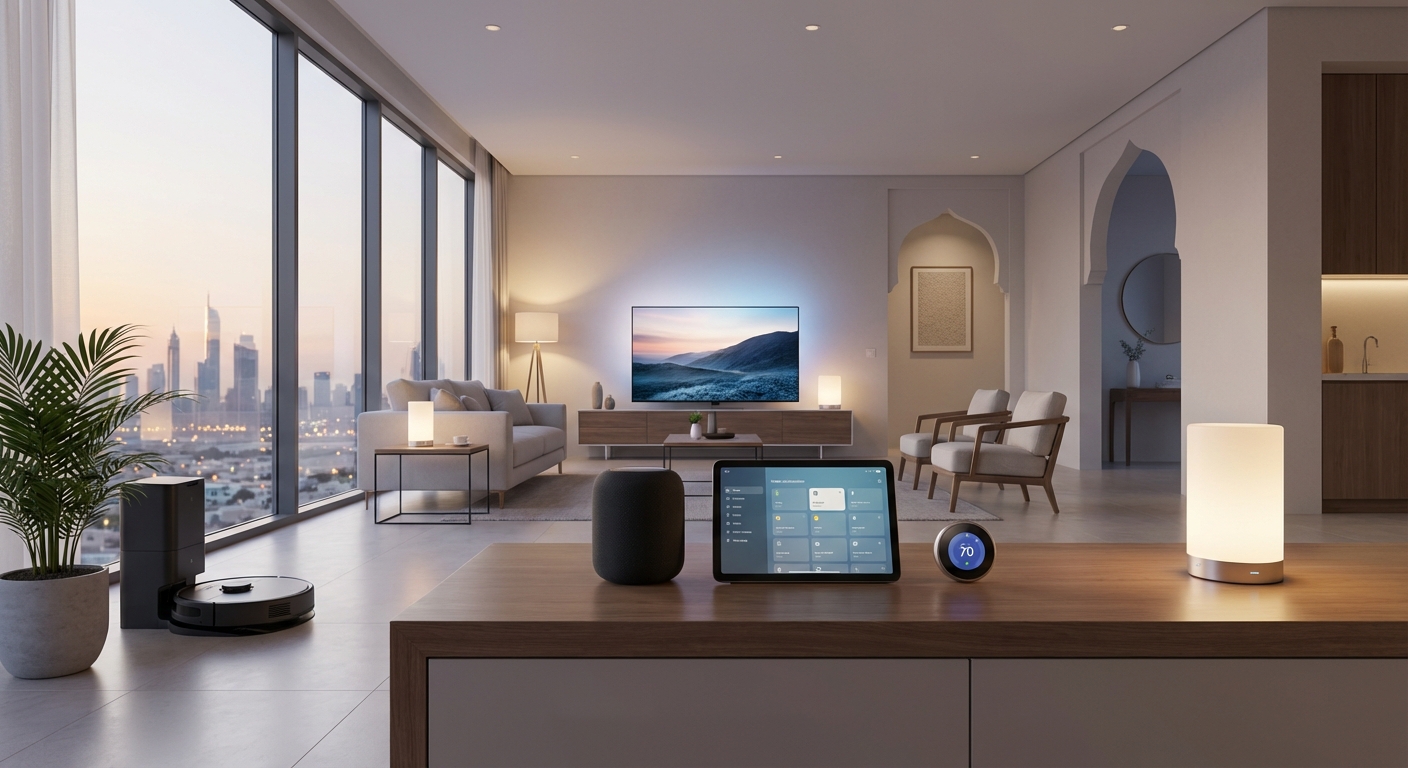
Living in a UAE apartment doesn’t mean you can’t enjoy the convenience of a fully connected home. Whether you’re renting in Dubai Marina or own a unit in Abu Dhabi’s Al Reem Island, the right smart devices can transform your space without permanent modifications or landlord headaches. The challenge? Picking devices that actually work with your apartment’s layout, your building’s infrastructure, and the region’s unique climate demands.
Smart home devices for UAE apartments must balance renter-friendly installation, climate adaptability, and local compatibility. Priority categories include wireless security cameras, smart thermostats for AC control, voice assistants with Arabic support, and automated lighting that works with existing fixtures. Most devices connect via WiFi or Zigbee hubs, requiring no permanent modifications. Budget between 500 AED for starter setups to 5,000+ AED for comprehensive systems.
Why UAE apartments need different smart home solutions
Apartment living in the Emirates presents unique challenges that villa owners never face. You can’t drill into every wall. Your AC system might be centralized. Building management controls certain utilities. And that blazing summer heat puts extra strain on any climate-related device.
The best smart home devices for apartments UAE must tick several boxes. They need wireless connectivity to avoid drilling. They should integrate with existing systems like split AC units. And they must handle the temperature swings between outdoor heat and indoor Arctic cooling.
Your building’s construction matters too. Those thick concrete walls in newer towers? They can block WiFi signals between rooms. Older buildings in areas like Bur Dubai might have inconsistent power delivery. These aren’t dealbreakers, but they affect which devices will actually work reliably.
Smart security devices that won’t anger your landlord
Security tops most apartment dwellers’ priority lists, especially in buildings with shared access points and delivery traffic.
Video doorbells have become essential in UAE apartments. The Ring Video Doorbell (Battery) works perfectly for renters because it mounts with adhesive backing or a simple bracket. No hardwiring needed. You get motion alerts, two-way audio, and video recording. The battery version costs around 399 AED and lasts 6-8 months per charge in moderate use.
Eufy’s battery-powered doorbell offers a strong alternative at 450 AED, with local storage that doesn’t require monthly cloud subscriptions. Important for privacy-conscious users who don’t want footage stored overseas.
Indoor cameras fill the gap for monitoring your space while traveling or at work. The TP-Link Tapo C200 (around 120 AED) delivers 1080p video, pan and tilt functions, and night vision. It sits on any shelf or mounts with included hardware. The Tapo app works smoothly on UAE internet connections.
For something more discreet, the Wyze Cam v3 (approximately 150 AED when available locally) offers excellent night vision and weather resistance if you want to monitor a balcony.
Smart locks get tricky in apartments. Many buildings prohibit changing door locks entirely. The August Smart Lock Pro solves this by fitting over your existing deadbolt, leaving the exterior unchanged. Your landlord’s key still works. You get keyless entry, temporary access codes for guests or cleaners, and auto-lock features. Expect to pay 800-1,000 AED.
The Yale Assure Lock SL works similarly but requires checking if your door’s deadbolt is compatible. Not all European-style apartment doors in older UAE buildings support these retrofit locks.
“In my experience with Dubai apartment clients, battery-powered security devices with cloud backup consistently outperform hardwired options. The flexibility matters more than the slight inconvenience of charging every few months.” – Home automation specialist, Dubai
Climate control that actually saves money
AC costs dominate utility bills across the UAE. Smart thermostats and controllers can cut those expenses by 20-30% without sacrificing comfort.
The Sensibo Sky (around 450 AED) turns any split AC unit into a smart device. It connects to your AC’s infrared receiver, learning your unit’s remote commands. You control temperature through the Sensibo app, set schedules, and enable geofencing so cooling starts when you’re 10 minutes from home.
Sensibo works with virtually every AC brand sold in the UAE, from Gree to Samsung to Mitsubishi. Installation takes five minutes. Stick the unit near your AC, connect to WiFi, and you’re done.
The tado° Smart AC Control V3+ (550 AED) adds more sophisticated features like open window detection and weather adaptation. If you leave a window open, it pauses cooling. When outdoor temperatures drop in winter months, it adjusts accordingly.
For apartments with ducted AC systems, the Ecobee SmartThermostat (around 900 AED) replaces your existing wall thermostat. This requires slightly more installation effort but works brilliantly in larger apartments with central HVAC. The included room sensors detect which spaces you’re actually using, focusing cooling where needed.
Smart plugs offer another angle. The Meross Smart Plug (60 AED) monitors energy consumption of individual devices. Plug your portable AC, dehumidifier, or fan into one and track exactly what’s draining power. Set schedules so devices turn off automatically when you leave for work.
Lighting systems for every budget and skill level
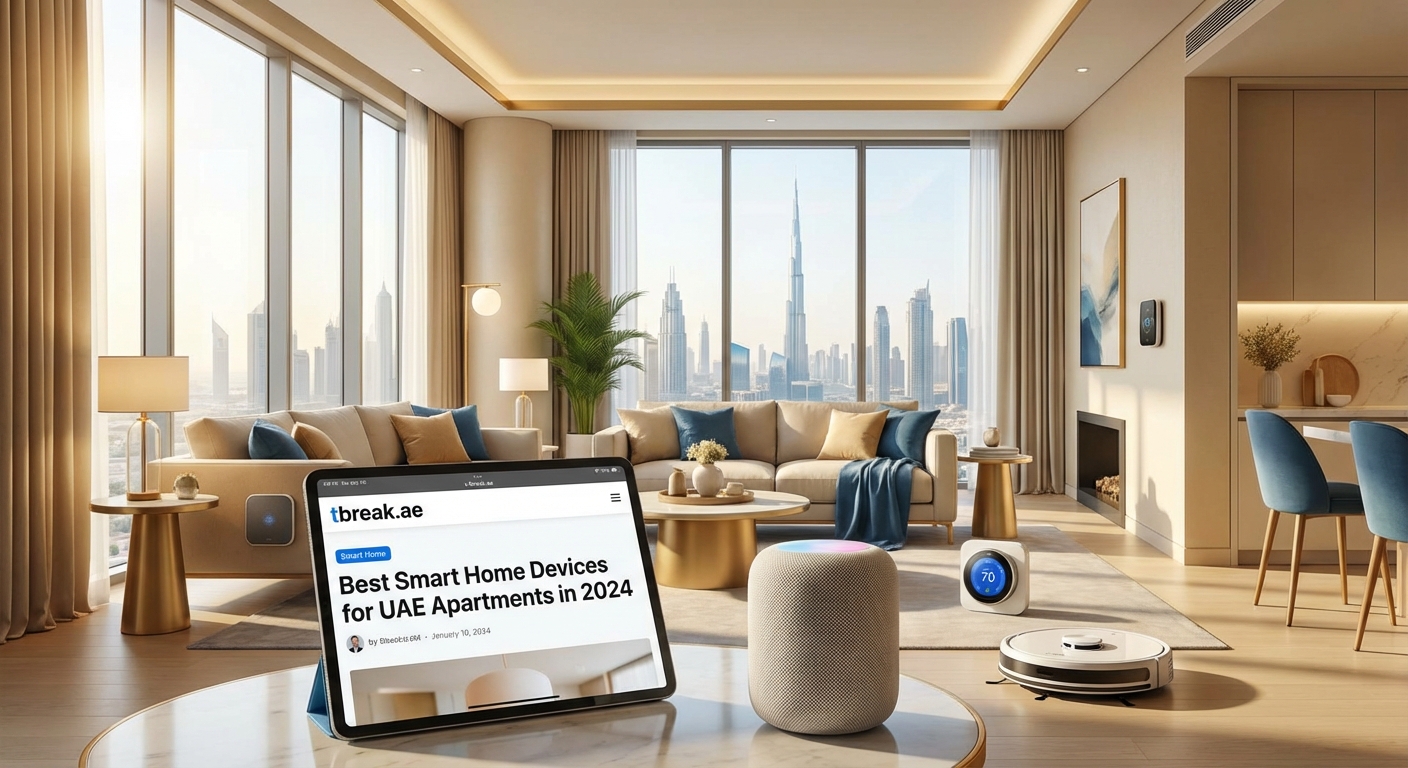
Smart lighting transforms apartment ambiance while offering practical benefits like remote control and energy savings.
Philips Hue remains the gold standard, though it’s pricey. A starter kit with three color bulbs and the required Hue Bridge costs around 600 AED. You get 16 million colors, dimming, schedules, and integration with every major voice assistant. The bulbs last years and work in standard E27 sockets common in UAE apartments.
The investment makes sense if you’re committed to building a comprehensive smart home. Hue bulbs sync with movies, music, and games. You can create lighting scenes for different moods or times of day.
Budget-conscious residents should consider TP-Link Tapo or Yeelight bulbs. Tapo’s color bulbs cost about 80 AED each and don’t require a hub. They connect directly to WiFi. The Tapo app offers scheduling, dimming, and color changes. Quality isn’t quite Hue level, but it’s impressive for the price.
Yeelight LED strips (120-200 AED depending on length) add accent lighting behind TVs, under cabinets, or along bedroom headboards. They stick with adhesive backing, perfect for renters. The strips support millions of colors and integrate with Google Home or Alexa.
For apartments with existing ceiling fixtures, smart switches make more sense than changing every bulb. The Aqara Smart Wall Switch (180 AED) replaces standard switches but requires a neutral wire, which not all UAE apartments have. Check your switch box first or call an electrician.
The Shelly 1 relay (around 70 AED) hides behind existing switches, making them smart without visible changes. This works better for rental situations where you can’t modify wall plates.
Voice assistants and smart hubs that speak your language
A central hub ties your devices together and enables voice control.
Amazon Echo Dot (5th Gen) costs around 199 AED and supports Arabic voice commands. This matters for family members more comfortable in Arabic or for controlling devices hands-free while cooking. The speaker quality improved significantly in the latest generation, making it viable for casual music listening.
Echo devices integrate seamlessly with Ring doorbells, Philips Hue, TP-Link devices, and hundreds of other brands. The Alexa app handles setup and routines like “good morning” commands that adjust lights, read news, and report weather.
Google Nest Mini (around 180 AED) offers Google Assistant with similar smart home compatibility. Google’s voice recognition handles mixed Arabic-English households better in my testing. The Nest ecosystem works particularly well if you use Nest cameras or thermostats.
Apple HomePod mini (399 AED) serves Apple ecosystem devotees. Siri’s smart home control lags behind Alexa and Google Assistant in device compatibility, but if you’re deep into iPhone, iPad, and Mac usage, the integration feels natural. HomeKit-compatible devices tend to cost more though.
The Aqara Hub M2 (around 250 AED) deserves mention as a dedicated Zigbee hub. It doesn’t have a speaker or voice assistant, but it connects Aqara sensors, switches, and other Zigbee devices to your WiFi network. This matters because Zigbee devices use less power and create mesh networks that extend range through your apartment.
Entertainment upgrades that don’t require renovation
Smart TVs dominate UAE electronics stores, but additional devices enhance the experience.
Streaming devices like the Amazon Fire TV Stick 4K (around 200 AED) or Google Chromecast with Google TV (250 AED) add smart features to older TVs or improve sluggish built-in smart TV interfaces. Both support local streaming services like OSN, Shahid, and StarzPlay alongside Netflix and Disney+.
The Fire TV Stick integrates with Alexa, letting you control playback, search content, and adjust volume by voice. Useful when your remote inevitably slides between couch cushions.
Smart soundbars improve apartment audio without the space and neighbor complaints that come with full surround systems. The Samsung HW-Q600B (around 1,200 AED) delivers Dolby Atmos from a single bar and wireless subwoofer. Setup takes minutes, no drilling required.
For music throughout your apartment, Sonos One SL speakers (around 900 AED each) create multi-room audio. Place one in your bedroom, another in the living room, and they play synchronized music or different content in each space. They’re WiFi-based, so no complicated wiring.
Budget alternative? Amazon Echo Studio (around 800 AED) offers impressive spatial audio and doubles as an Alexa smart home controller.
Kitchen and cleaning automation for busy professionals
UAE professionals work long hours. Smart kitchen and cleaning devices reclaim time.
The Instant Pot Smart WiFi (around 600 AED) lets you start cooking from your office. Load ingredients in the morning, trigger cooking an hour before you leave work, and arrive home to a ready meal. The app includes hundreds of recipes with automatic settings.
Smart coffee makers like the Smarter Coffee 2nd Generation (500 AED) brew on schedule or via app command. Wake up to fresh coffee or trigger brewing when your morning alarm goes off.
Robot vacuums have become apartment essentials. The Roborock Q5+ (around 1,800 AED) handles the tile and marble floors common in UAE apartments brilliantly. It maps your space, avoids obstacles, and empties itself into a base station. Run it while you’re at work and return to clean floors.
For tighter budgets, the Eufy RoboVac 11S (around 700 AED) lacks mapping and self-emptying but cleans effectively in smaller apartments. It’s thin enough to slide under most furniture.
The Xiaomi Mi Air Purifier 3H (around 500 AED) matters more than you’d think. Dubai’s dust and construction activity means indoor air quality suffers. This purifier monitors air quality, adjusts fan speed automatically, and connects to the Mi Home app for remote control and scheduling.
Setting up your smart apartment step by step
Getting started feels overwhelming, but following a logical sequence prevents compatibility headaches and wasted money.
-
Assess your WiFi coverage before buying anything. Walk through your apartment with your phone, checking signal strength in every room. Weak spots need addressing first with a mesh WiFi system like the TP-Link Deco M4 (around 400 AED for a 2-pack). Most smart devices need reliable WiFi.
-
Choose your voice assistant ecosystem early. Mixing Amazon, Google, and Apple devices works but creates unnecessary complexity. Pick one based on what you already use. iPhone users lean Apple. Android users typically prefer Google. Everyone else finds Amazon’s device compatibility broadest.
-
Start with security and climate control since these deliver immediate value. A video doorbell and smart AC controller provide security and savings from day one.
-
Add lighting gradually, starting with the rooms you use most. Living room and bedroom make sense before guest rooms or storage areas.
-
Integrate entertainment and convenience devices last. These enhance quality of life but aren’t essential for basic smart home functionality.
-
Test each device individually before adding the next. Confirm it connects, responds reliably, and does what you need. This isolates problems instead of troubleshooting five new devices simultaneously.
Common mistakes UAE apartment dwellers make
| Mistake | Why it happens | How to avoid it |
|---|---|---|
| Buying devices that need hardwiring | Not checking installation requirements | Always verify “battery” or “wireless” in product descriptions |
| Ignoring WiFi compatibility | Assuming all devices work on any network | Confirm devices support 2.4GHz WiFi (many only work on this band, not 5GHz) |
| Skipping the hub requirement | Not reading that Zigbee/Z-Wave need hubs | Check if devices need additional hardware beyond WiFi |
| Forgetting to check voltage | UAE uses 220-240V | Verify devices support local voltage or buy appropriate adapters |
| Overlooking Arabic language support | Assuming all assistants speak Arabic | Confirm language options if non-English speakers use the system |
| Buying incompatible smart locks | Not measuring existing deadbolts | Measure your door hardware before purchasing retrofit locks |
Budget planning for different apartment sizes
Your apartment size and priorities determine realistic budgets.
Studio or 1-bedroom starter setup (1,500-2,500 AED):
– Smart speaker with voice assistant: 200 AED
– Video doorbell: 400 AED
– Smart AC controller: 450 AED
– Smart bulbs for main living area (3-4 bulbs): 300 AED
– Smart plug (2-pack): 120 AED
– Basic robot vacuum: 700 AED
2-bedroom comprehensive system (4,000-6,000 AED):
– Premium voice assistant: 400 AED
– Video doorbell with subscription: 600 AED
– Smart AC controllers (2 units): 900 AED
– Philips Hue starter kit plus additional bulbs: 1,000 AED
– Smart lock: 900 AED
– Mid-range robot vacuum with mapping: 1,800 AED
– Indoor security camera: 400 AED
3-bedroom luxury automation (8,000-12,000 AED):
– Multiple smart speakers/displays: 1,200 AED
– Video doorbell and outdoor camera: 1,200 AED
– Smart AC controllers (3+ units): 1,400 AED
– Complete Philips Hue lighting system: 2,500 AED
– Premium smart lock: 1,200 AED
– High-end robot vacuum with self-emptying: 2,500 AED
– Smart soundbar: 1,500 AED
– Air purifiers (2 units): 1,000 AED
– Smart kitchen appliances: 1,500 AED
These budgets assume you’re buying quality devices that will last years. Cheaper alternatives exist but often frustrate users with connectivity issues or poor app experiences.
Where to buy smart home devices in the UAE
Local availability matters because international shipping adds costs and delays warranty claims.
Physical retailers like Sharaf DG, Jumbo Electronics, and Carrefour stock popular brands. You can see devices before buying and get immediate assistance. Prices run slightly higher than online but the convenience and return policies help.
Noon.com and Amazon.ae offer broader selection and competitive pricing. Both deliver across the UAE within 1-2 days in major cities. Check seller ratings carefully. Stick with “Fulfilled by Noon” or “Fulfilled by Amazon” listings for reliable delivery and returns.
Manufacturer websites like Philips Hue UAE, Sonos, and Aqara sometimes offer exclusive bundles or newer products not yet in retail channels.
Specialty smart home retailers like MySmartHome.ae focus specifically on home automation. Their staff understands compatibility questions better than general electronics store employees. Prices sit between physical retail and online marketplaces.
Avoid buying smart home devices from international Amazon sites (Amazon.com, Amazon.co.uk) unless you confirm warranty coverage in the UAE. Many manufacturers won’t honor international warranties locally.
Maintaining and upgrading your smart home
Smart devices aren’t set-and-forget purchases. They need occasional attention.
Firmware updates happen automatically for most devices but sometimes require manual approval. Check your device apps monthly for pending updates. These often fix security vulnerabilities or add features.
Battery maintenance for wireless devices means keeping spare batteries on hand. Video doorbells, smart locks, and sensors eventually need charging or battery replacement. Set calendar reminders based on typical battery life.
Network changes like new WiFi passwords require updating every connected device. Document your smart home devices in a spreadsheet so you remember what needs updating when you change routers or internet providers.
Expanding gradually works better than buying everything at once. Add devices as you identify needs. That guest room doesn’t need smart lighting until you actually host guests regularly. Your kitchen might not need a smart coffee maker if you don’t drink coffee.
Selling or moving considerations matter in rental situations. Battery-powered and plug-in devices move with you easily. Installed smart switches or thermostats might stay with the apartment, so factor replacement costs into your budget.
For tech enthusiasts who also appreciate gaming laptops under 5000 AED available in UAE and Saudi Arabia, the same research approach applies. Compare specs, read local reviews, and buy from retailers with solid return policies.
Making your apartment truly smart
Smart home technology has matured past the early adopter phase. The devices work reliably. Setup has gotten simpler. And prices have dropped to reasonable levels for middle-income professionals.
Your UAE apartment can feel as modern and convenient as any villa, without permanent modifications or landlord conflicts. Start with the basics that solve real problems: security, climate control, and lighting. Build from there based on your lifestyle and budget.
The best smart home is one you actually use daily, not an expensive collection gathering dust. Choose devices that genuinely improve your routine, whether that’s arriving to a cool apartment, checking who’s at your door from work, or waking to automated coffee and lighting.
Your connected apartment awaits. Pick one device category, research your options, and make that first purchase. You’ll wonder how you managed without it.
Leave a Reply