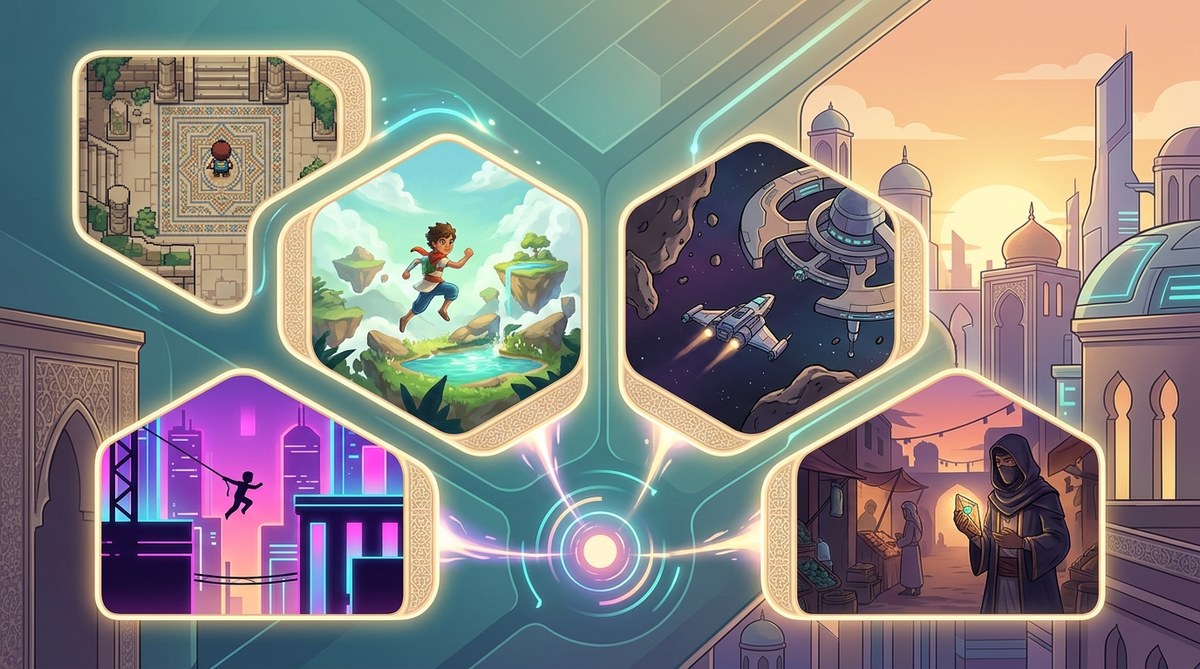
5 Must-Play Indie Games from Middle Eastern Developers in 2026
The Middle East is having a quiet revolution, and it is happening one pixel at a time. For years, gamers in the UAE, Saudi Arabia, and across the region had to look abroad for fresh experiences. That is changing fast. In 2026, independent developers from the Middle East are crafting worlds that feel personal, rooted, and completely unlike anything coming out of the usual gaming hubs. These are not small experiments. They are full hearted stories, clever mechanics, and visual styles that borrow from centuries of art and architecture you rarely see in a triple-A release. If you only play the big studio titles, you are missing out on the most exciting creativity happening in gaming right now.
Indie games from the Middle East are no longer a niche curiosity. In 2026, studios from Saudi Arabia, the UAE, Palestine, Iran, and Egypt are releasing titles that compete on quality while offering stories and settings the global market has never seen. This list covers five essential games that showcase the region’s creative range. Support them, share them, and watch this scene grow.
Why Middle Eastern Indie Games Deserve Your Attention
The global gaming industry is worth hundreds of billions, but the stories it tells often come from the same handful of cities. Los Angeles, Tokyo, London, Montreal. The Middle East has been treated as a market to sell into, not a place where great games are made. That assumption is crumbling in 2026.
Investment from programs like Saudi Arabia’s Gaming Vision 2030 has poured resources into local studios. Incubators in Dubai and Abu Dhabi are nurturing first-time developers. And most importantly, a generation of creators who grew up playing Minecraft, PUBG, and Final Fantasy now have the tools and confidence to build games about their own lives.
The result is a wave of indie titles that feel fresh not because they chase trends, but because they do not. They draw from folklore, family traditions, bustling city streets, and landscapes that range from endless sand seas to ancient mountain villages. These games are not trying to be the next Call of Duty. They are trying to tell you something about where they come from.
Five Indie Games from the Middle East You Need to Play in 2026
1. Kunafa: A Baker’s Tale
Developer: Nablus Workshop (Palestine)
Platforms: PC, Nintendo Switch, Xbox Series X|S
This game smells like rose water and nostalgia. You play as a young Palestinian woman who inherits her grandmother’s kunafa shop in the old city of Nablus. The gameplay blends time management, recipe discovery, and relationship building. You must balance the demands of customers, learn secret family recipes hidden in old letters, and decide whether to modernize the shop or keep traditions alive.
The art style uses warm earth tones and hand drawn textures that mimic the tiles and stonework of historic Nablus. Each customer has a story. An elderly man who wants the exact same kunafa his wife used to make. A tourist who does not understand why the shop closes for afternoon prayer. A cousin who wants to turn the shop into a fast food franchise.
“The Middle Eastern indie scene is driven by stories that only we can tell. Our games carry the scent of oud, the warmth of family gatherings, and the colors of our bustling souks. We are not trying to copy Western games; we are building something entirely our own.” – Layla Al-Rashid, founder of Sandbox Studios
Kunafa: A Baker’s Tale is a slow game in the best way. It asks you to care about small things. A perfectly golden crust. A customer who leaves happy. A recipe passed down through generations. It is comfort food in video game form.
2. Dune Dwellers
Developer: Rub Al Khali Games (Saudi Arabia)
Platforms: PC, PlayStation 5
Survival games are everywhere, but none feel quite like this. Dune Dwellers drops you into the Rub al Khali, the Empty Quarter, one of the most punishing environments on Earth. You play as a lost navigator who must reach the legendary lost city of Ubar before your water runs out.
The game does not hold your hand. There is no mini-map. No quest markers. You navigate by the stars, by reading dune shapes, and by paying attention to desert wildlife. The wind shifts sand dunes in real time, burying landmarks and forcing you to adapt. Night temperatures drop dangerously low. Sandstorms blind you for minutes at a time.
What makes Dune Dwellers special is its respect for Bedouin survival knowledge. The developers worked with historians and desert guides to build a game that treats traditional navigation and survival skills as actual gameplay mechanics, not window dressing. Every tool you use, from the way you read wind patterns to how you conserve water, has roots in real desert wisdom.
This is a hard game. But the satisfaction of cresting a dune and spotting the glint of Ubar’s towers on the horizon is unmatched.
3. Souk Stories
Developer: Al Fahidi Interactive (UAE)
Platforms: PC, mobile (iOS and Android)
Not every great game needs a powerful console. Souk Stories is a narrative adventure designed for mobile devices, and it is one of the most charming games to come out of the UAE. You play as Noora, a ten-year-old Emirati girl who helps her grandfather run a spice shop in the Al Fahidi Historical District of Dubai.
The gameplay is built around observation and conversation. Customers come to the shop, and you must figure out what they actually need, not just what they ask for. A woman says she wants saffron for a dinner party, but her tone suggests she is lonely and wants someone to talk to. A man asks for a rare spice, but his accent reveals he is not from the Gulf and might be homesick.
Noora’s choices shape how the story unfolds. Help too many people and you might close the shop late. Focus only on sales and you miss the human moments. The game is a gentle meditation on community, empathy, and the dying art of the neighborhood shopkeeper who knows everyone’s name.
It runs smoothly on any phone from the last three years, making it the most accessible game on this list.
4. Persian Voyager
Developer: Simorgh Studio (Iran)
Platforms: PC, PlayStation 5, Xbox Series X|S
The Indian Ocean trade routes of the 10th century come alive in Persian Voyager. You command a traditional dhow, crewed by sailors from across the Persian Gulf, East Africa, and India. Your goal is to establish trade routes, survive monsoon storms, and navigate by celestial navigation.
This is not a combat game. You cannot sink other ships or raid ports. The tension comes from resource management, crew morale, and the sea itself. A bad storm can damage your hull. A wrong reading of the stars can send you days off course. Your crew has different cultural backgrounds and religious practices, and keeping them happy requires attention and respect.
The map stretches from the coast of Zanzibar to the ports of Gujarat, with stops in Oman, Yemen, and the islands of the Maldives. Each port has its own economy, languages, and goods. The game teaches you about real history without ever feeling like a textbook.
Persian Voyager is a meditation on exploration and connection. It argues that trade routes were not just about silk and spices. They were about ideas, stories, and people meeting across vast distances.
5. Cairo Rooftops
Developer: Nile Valley Games (Egypt)
Platforms: PC, PlayStation 5, Xbox Series X|S
Cairo has one of the most iconic skylines in the world, and Cairo Rooftops lets you run across it. You play as Youssef, a street artist who uses the rooftops of Cairo to move unseen across the city while leaving murals that tell the stories of people the city has forgotten.
The parkour system is fluid and responsive. You leap between buildings, shimmy along washing lines, climb water towers, and drop into hidden courtyards. The rooftops are a world unto themselves. Satellite dishes, pigeon coops, makeshift gardens, and laundry create obstacles and pathways. Below you, the chaos of Cairo honks and bustles. Above you, only the sky.
The story missions take you to different neighborhoods. The historic district of Islamic Cairo. The modernist towers of Zamalek. The sprawling informal settlements on the city’s edge. Each area has its own look, its own challenges, and its own stories.
What makes Cairo Rooftops stand out is its love for the city. The developers photographed hundreds of rooftops to capture the detail. The game treats Cairo not as a backdrop but as a character. It is loud, crowded, beautiful, and impossible to forget.
A Handy Comparison of the Five Games
| Game | Developer Location | Genre | Platforms | Estimated Playtime |
|---|---|---|---|---|
| Kunafa: A Baker’s Tale | Palestine | Narrative management | PC, Switch, Xbox | 12 to 18 hours |
| Dune Dwellers | Saudi Arabia | Survival exploration | PC, PS5 | 25 to 40 hours |
| Souk Stories | UAE | Narrative adventure | PC, iOS, Android | 6 to 10 hours |
| Persian Voyager | Iran | Trade simulation | PC, PS5, Xbox | 20 to 35 hours |
| Cairo Rooftops | Egypt | Parkour narrative | PC, PS5, Xbox | 15 to 22 hours |
How to Find More Indie Games from the Region
If you want to keep discovering games like these, here are three practical steps you can take:
-
Follow regional game festivals. Events like the Dubai Esports and Games Festival, the Saudi Gamers Festival, and the Middle East Gaming Expo showcase indie developers. Many of them offer demo booths where you can try unreleased games.
-
Check the regional storefronts. Steam and the Epic Games Store now have curated collections for Middle Eastern games. Search for tags like “MENA developer,” “Arabic language,” or “Middle East setting” to find new releases.
-
Join local Discord and Reddit communities. Communities like r/MiddleEastGamers and various Gulf-based gaming Discords are where developers post early builds and ask for playtesters. You can find games months before they get mainstream coverage.
These steps also help the broader Middle Eastern gaming ecosystem grow. Every wishlist, every review, and every share signals to platforms and publishers that this audience matters.
What to Look for in a Middle Eastern Indie Game
Not every indie game from the region is worth your time. Here are some signals that a game has real quality:
- The developers have a clear cultural perspective. They are not just using Middle Eastern aesthetics as skin; the setting affects the story and mechanics.
- The game has been shown at regional or international festivals. Look for mentions of events like Game Connection, Tokyo Game Show, or regional showcases.
- Reviews from local players are positive. A game that resonates with people who actually live in the region will feel authentic.
- The game supports Arabic language options, even if it also supports English. This shows the developer is building for their home audience first.
The Bigger Picture: A Region Finding Its Voice
The five games on this list are just the beginning. Across the Middle East, small teams are building games about everything from Omani fishing villages to Lebanese civil war memory projects to futuristic sci-fi set in Doha. The indie scene here is not a trend. It is the result of years of infrastructure building, education, and a simple truth: great stories can come from anywhere.
When you play Kunafa: A Baker’s Tale, you are not just playing a game. You are tasting a memory of a grandmother’s kitchen in Nablus. When you navigate the dunes in Dune Dwellers, you are learning skills that travelers have used for centuries. When you run across the rooftops of Cairo, you are seeing a city that most tourists never glimpse.
Middle Eastern indie games in 2026 are a gift. They offer perspectives that the rest of the industry has ignored for too long.
So pick one. Start with Souk Stories if you want something short and heartfelt. Try Dune Dwellers if you are ready for a challenge. Buy them, play them, and tell a friend about them. That is how a scene grows. That is how new voices get heard. And that is how you, as a player, get to experience something you could not find anywhere else.



Post Comment