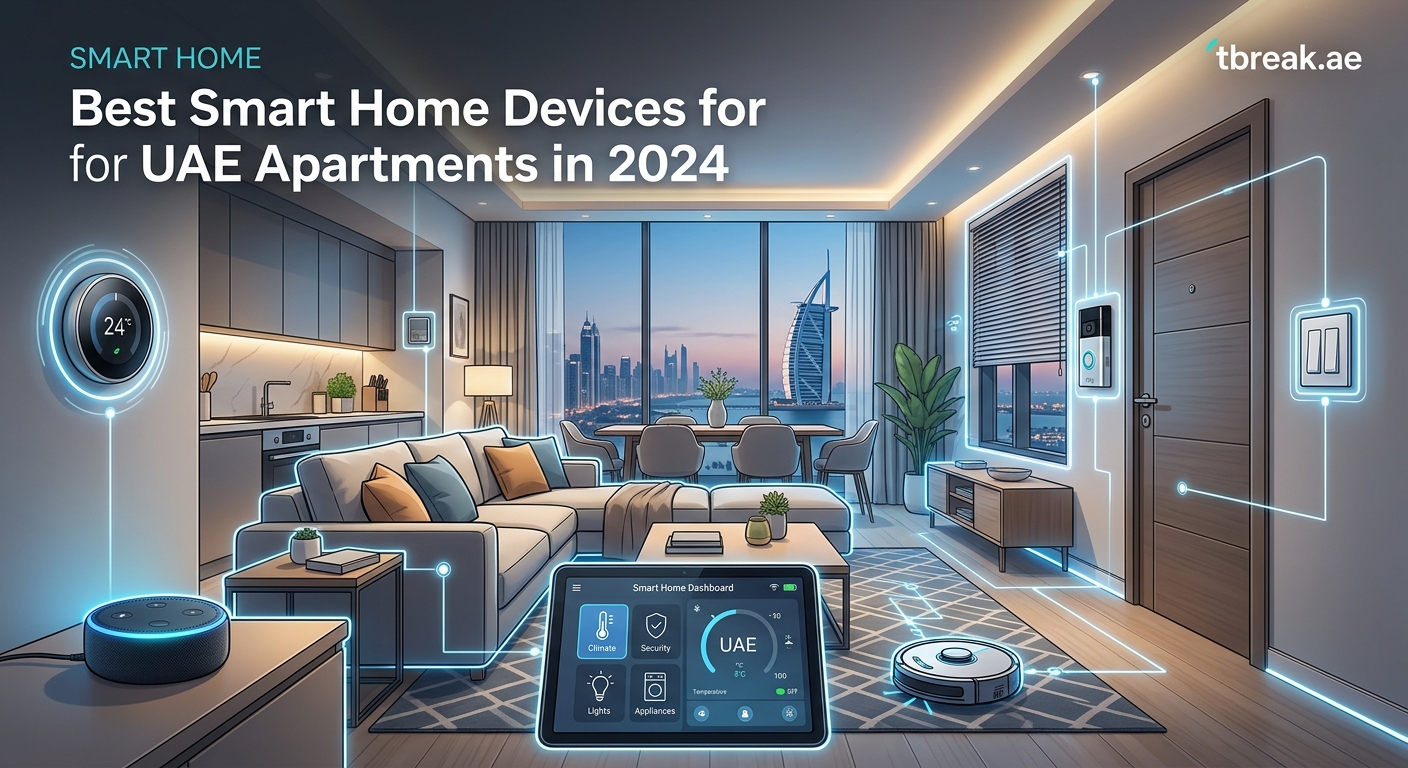
Best Smart Home Devices for UAE Apartments in 2026
Living in a UAE apartment comes with unique challenges. Space is limited, drilling into walls might violate your lease, and the summer heat pushes your DEWA bill through the roof. But smart home technology can solve these problems without requiring a full renovation or landlord approval.
Smart home devices transform UAE apartments through wireless installation, energy savings, and remote control. Focus on climate control, lighting, security cameras, and voice assistants that work with regional power standards. Most devices install without drilling, making them perfect for renters. Budget 1,500 to 4,000 AED for a complete starter setup that cuts utility bills and adds convenience to daily life.
Understanding apartment constraints in the UAE
Most UAE apartments share similar limitations. You cannot make permanent changes to walls or electrical systems. Space is at a premium, especially in Dubai Marina, Business Bay, or Downtown towers. The extreme summer climate means air conditioning runs constantly from May through September.
These factors shape which smart home devices actually work for apartment living. Wireless devices win over hardwired systems. Compact designs beat bulky installations. Energy monitoring becomes essential when DEWA bills spike above 800 AED monthly.
Regional availability matters too. Not every smart home brand ships to the UAE, and some devices lack Arabic language support or local warranty coverage. Choosing products available through Noon, Amazon.ae, or local retailers like Sharaf DG ensures you get support when needed.
Smart lighting systems that need no rewiring
Traditional smart bulbs remain the easiest entry point. Philips Hue bulbs screw into existing fixtures and connect via a small hub plugged into your router. You control brightness, color temperature, and scheduling through an app.
The Philips Hue White and Color Ambiance starter kit costs around 400 AED and includes three bulbs plus the hub. This covers a typical living room or bedroom. Add bulbs individually as needed, with each costing 80 to 120 AED depending on features.
TP-Link Kasa smart bulbs offer a budget alternative at 60 AED per bulb. They connect directly to WiFi without requiring a separate hub. The tradeoff is fewer color options and slightly slower response times.
For apartments with recessed lighting, smart switches make more sense than replacing every bulb. The Aqara wireless switch attaches over your existing switch using adhesive backing. No drilling required. It sends signals to a small hub that controls power to the lights.
Install smart lighting in phases. Start with your main living area, test the system for two weeks, then expand to bedrooms and kitchen. This prevents buyer’s remorse and helps you understand which features you actually use daily.
Climate control devices that slash DEWA bills
Air conditioning dominates UAE electricity consumption. A smart thermostat or AC controller can reduce cooling costs by 20 to 30 percent through better scheduling and temperature management.
The Sensibo Sky works with existing split AC units common in UAE apartments. This small device attaches near your AC unit, learns your cooling patterns, and adjusts temperature based on occupancy. It costs 350 AED and installs in five minutes without tools.
Sensibo integrates with your phone’s location services. When you leave home, it raises the temperature to 26°C. Thirty minutes before you typically return, it cools the apartment back to 22°C. You arrive to comfort without paying to cool an empty space all day.
Smart plugs add intelligence to older AC units or fans. The Meross Matter smart plug costs 45 AED and handles up to 16 amps. Plug your standing fan into it, then schedule operation through the app. Run fans only during peak heat hours instead of 24/7.
For apartments with central AC controlled by a wall thermostat, the Ecobee SmartThermostat offers room sensors that detect occupancy. Place sensors in bedrooms and living areas. The system focuses cooling where people actually are, not empty rooms. This model costs around 900 AED but pays for itself within 18 months through energy savings.
Security cameras designed for rental properties
Landlords rarely permit drilling holes for wired security systems. Battery-powered cameras solve this problem while providing genuine protection.
The Eufy Indoor Cam 2K costs 180 AED and sits on any shelf or mounts with adhesive strips. It records 2K resolution video, includes two-way audio for speaking to visitors or pets, and stores footage locally on a microSD card. No monthly subscription required.
For monitoring your front door, the Aqara G4 Video Doorbell mounts using the existing peephole. Remove your current peephole, screw in the Aqara unit, and you have a smart doorbell without drilling new holes or running wires. It costs 650 AED and includes six months of cloud storage.
The Ring Indoor Cam offers another solid option at 200 AED. It integrates well with Alexa voice commands and provides clear 1080p video. Ring does push its subscription service heavily, but basic motion alerts work without paying monthly fees.
| Camera Model | Price (AED) | Power Source | Key Feature | Best For |
|---|---|---|---|---|
| Eufy Indoor Cam 2K | 180 | USB cable | Local storage | Privacy-conscious users |
| Aqara G4 Doorbell | 650 | Battery | Peephole mount | Front door monitoring |
| Ring Indoor Cam | 200 | USB cable | Alexa integration | Echo device owners |
| Wyze Cam v3 | 150 | USB cable | Budget pricing | Multi-room coverage |
Position cameras to cover entry points and valuable items. Avoid pointing them at neighbors’ windows or building hallways, which may violate privacy regulations in the UAE.
Voice assistants that control everything
A voice assistant acts as the command center for your smart home. You speak requests instead of opening multiple apps.
Amazon Echo Dot (5th generation) costs 180 AED and handles most smart home control tasks. It connects with thousands of compatible devices, plays music, sets timers, and answers questions. The compact design fits on crowded nightstands or kitchen counters.
Google Nest Mini offers similar functionality at 150 AED. It excels at answering complex questions and integrates naturally with Google services like Calendar and Gmail. Choose this if you use Android phones and Chromecast devices.
Apple HomePod Mini costs 400 AED and works best for iPhone users invested in the Apple ecosystem. Siri understands Arabic commands better than competing assistants, making it valuable for multilingual households.
Setting up voice control follows a simple process:
- Place your voice assistant in a central location where it hears commands from multiple rooms
- Download the companion app and connect the device to your WiFi network
- Add your smart home devices one by one through the app’s device discovery feature
- Create routines that trigger multiple actions with a single voice command
- Test each routine during different times of day to ensure reliability
The real power emerges when you create routines. Say “Alexa, good morning” and your lights turn on, blinds open, AC adjusts to 24°C, and your favorite news podcast starts playing. One command replaces five separate actions.
Smart plugs for instant device automation
Smart plugs convert any appliance into a connected device. They cost 40 to 80 AED each and require zero installation skill.
The TP-Link Tapo P110M includes energy monitoring. Plug in your coffee maker, check how much power it draws, and schedule it to start brewing at 6:45 AM every weekday. The plug tracks total energy consumption, helping identify which appliances drive your electricity bill higher.
Meross smart plugs support Matter, the new smart home standard that ensures compatibility across Apple, Google, and Amazon ecosystems. This future-proofs your investment as you add devices from different brands.
Common smart plug applications in UAE apartments:
- Schedule floor lamps to turn on at sunset, creating the appearance of occupancy when traveling
- Cut power to phone chargers after batteries reach 100 percent, extending device lifespan
- Control window AC units from bed without getting up
- Power cycle routers remotely when internet connection drops
- Run dehumidifiers only during high-humidity hours
Avoid plugging heat-generating appliances like space heaters or irons into smart plugs. The added connection point creates potential fire hazards. Stick with low-power devices like lamps, fans, and electronics.
Automated curtains and blinds
Electric curtain motors transform manual curtains into automated window coverings. The SwitchBot Curtain costs 280 AED per unit and clips onto existing curtain rods. No drilling, no rewiring, just clip and go.
These motors connect via Bluetooth or WiFi, allowing app control and scheduling. Program curtains to open at 7 AM for natural wake-up lighting, then close at 2 PM to block intense afternoon sun that forces your AC to work harder.
For apartments with vertical blinds, the Aqara Roller Shade Driver E1 costs 450 AED and mounts to the blind mechanism using included brackets. It handles blinds up to 3 meters wide and runs for six months on a single battery charge.
Automated window coverings deliver surprising energy savings. Closing curtains during peak sun hours (noon to 4 PM) can reduce AC load by 15 percent. Over a summer, that saves 150 to 200 AED on electricity bills.
Smart locks for keyless entry
Changing your apartment door lock requires landlord permission in most UAE buildings. Smart locks that work with existing deadbolts offer a middle ground.
The August WiFi Smart Lock costs 800 AED and installs on the interior side of your door. Your existing key and lock remain functional from the outside. Inside, you gain app control, temporary access codes for guests, and automatic locking when you leave.
This design means you can remove the smart lock when moving out, returning the door to its original state. No permanent modifications, no security deposit deductions.
The Aqara U100 Smart Lock costs 650 AED and includes a fingerprint reader. Register up to 50 fingerprints for family members and trusted friends. Kids cannot lose keys they do not carry.
For apartments where changing the lock is permitted, the Philips 7300 Series costs 1,200 AED and replaces your entire lock mechanism. It includes a number pad, fingerprint reader, RFID cards, and traditional key backup. This model meets UAE fire safety requirements by allowing manual unlocking during power failures.
Water leak detectors that prevent disasters
Water damage from AC condensation leaks, washing machine failures, or bathroom floods can cost thousands in repairs and lost security deposits. Water leak detectors provide early warning before minor drips become major problems.
The Aqara Water Leak Sensor costs 80 AED and sits on floors near potential leak sources. When water touches the sensor, it sends an alert to your phone and triggers a loud alarm. Place sensors under kitchen sinks, behind washing machines, near water heaters, and under AC units.
These sensors run on coin cell batteries lasting up to two years. They connect through a small hub that also supports other Aqara devices, making them cost-effective additions to existing systems.
For apartments with elderly residents or frequent travelers, leak detectors paired with smart water valves offer complete protection. The Flo by Moen system costs 1,800 AED but automatically shuts off water supply when detecting leaks. This prevents flooding when no one is home to respond to alerts.
Building your smart home in phases
Trying to automate everything at once leads to frustration and wasted money. A phased approach works better.
Phase 1 (Budget: 800 AED): Start with basics that deliver immediate value. Buy one voice assistant, two smart bulbs, and two smart plugs. Spend two weeks learning how these devices work and which features you actually use. Many people discover they never touch 70 percent of available features.
Phase 2 (Budget: 1,000 AED): Add climate control through a smart AC controller and security with one indoor camera. These devices address the biggest pain points in UAE apartment living: high electricity bills and security concerns when traveling.
Phase 3 (Budget: 1,200 AED): Expand with automated curtains, additional cameras, and more smart bulbs. By this point, you understand your preferences and can choose devices that match your actual usage patterns instead of marketing promises.
Phase 4 (Budget: 1,000+ AED): Consider premium additions like smart locks, water leak detectors, or whole-home mesh WiFi systems that ensure reliable connectivity for all your devices.
This phased approach spreads costs over six to twelve months while preventing the common mistake of buying incompatible devices from different ecosystems.
Avoiding common smart home mistakes
New smart home users make predictable errors. Learning from others saves money and frustration.
Mixing too many ecosystems: Sticking primarily with one ecosystem (Apple HomeKit, Google Home, or Amazon Alexa) ensures devices work together smoothly. Mixing all three creates compatibility headaches and requires multiple apps to control everything.
Ignoring WiFi capacity: Most apartment routers handle 15 to 20 connected devices before performance degrades. Smart homes easily exceed this limit. Upgrading to a mesh WiFi system like TP-Link Deco X20 (500 AED for two units) solves connectivity problems before they start. This relates to why devices that work well in Middle Eastern climate conditions often emphasize reliable wireless connectivity.
Skipping security settings: Change default passwords on every device. Enable two-factor authentication on your smart home apps. Update device firmware regularly. UAE residents face sophisticated cyber threats, and poorly secured smart homes provide easy entry points.
Buying cheap knockoffs: Unknown brands on noon.ae or Amazon.ae often lack proper certifications for UAE electrical standards. They may work initially but fail within months or, worse, create fire hazards. Stick with established brands that offer local warranty support.
Where to buy smart home devices in the UAE
Regional availability affects which devices make sense for your apartment. Some products ship only to Western markets, leaving you without warranty coverage or technical support.
Noon.ae: Carries most major brands with fast delivery across the UAE. Their electronics section includes Philips Hue, TP-Link, Aqara, and Eufy products. Noon’s return policy gives you 15 days to test devices and return anything that does not meet expectations.
Amazon.ae: Offers the widest selection but watch for third-party sellers shipping from abroad. Items sold directly by Amazon.ae include local warranty coverage. Prime members get free same-day delivery in Dubai and next-day in other emirates.
Sharaf DG: Physical stores let you see devices before buying. Staff can answer basic questions, though their smart home expertise varies by location. Prices run 10 to 15 percent higher than online retailers, but you get immediate possession.
Virgin Megastore: Stocks premium smart home brands like Sonos, Philips Hue, and Nest. Their Mall of the Emirates and Dubai Mall locations include demonstration areas where you can test devices.
Carrefour: Budget-friendly options from brands like Xiaomi and generic smart plugs. Quality varies, but prices undercut specialized retailers by 20 to 30 percent. Good for testing smart home concepts before investing in premium gear.
Making smart homes work in shared spaces
Roommates and family members need access to smart home controls without compromising security. Most systems support multiple users with different permission levels.
Create separate user accounts for each household member. Parents can restrict kids from adjusting thermostat settings or disabling security cameras. Roommates get control over shared spaces like the living room but not private bedrooms.
Guest access works through temporary codes or time-limited permissions. Give your cleaner a smart lock code that works only on Tuesday mornings from 9 AM to noon. The code automatically expires, eliminating the security risk of physical keys floating around.
Voice assistants recognize different voices and provide personalized responses. Your Spotify playlists differ from your roommate’s preferences. The assistant learns these differences and responds appropriately when each person speaks.
Energy monitoring and DEWA bill management
Smart plugs with energy monitoring reveal which appliances drive electricity costs higher. The data often surprises users.
Old refrigerators can consume 40 to 50 percent more power than modern energy-efficient models. Smart plugs quantify this waste, helping you decide whether replacement makes financial sense. A new refrigerator costs 1,500 AED but might save 30 AED monthly on electricity, paying for itself within five years.
Phantom power drain from devices in standby mode adds up. Game consoles, set-top boxes, and desktop computers draw power even when “off.” Smart plugs can cut power completely during unused hours, typically saving 50 to 80 AED annually per device.
Track your total smart home energy consumption through apps like TP-Link Kasa or Meross. Set monthly electricity budgets and receive alerts when approaching limits. This awareness alone reduces consumption by 10 to 15 percent as you become conscious of wasteful habits.
Integration with existing building systems
Many newer UAE apartment buildings include basic automation like access cards and intercom systems. Smart home devices can complement rather than replace these systems.
Video doorbells work alongside building intercoms. When someone buzzes your apartment, both systems alert you. The video doorbell provides visual confirmation before you grant access through the building system.
Smart locks do not replace building access requirements. Visitors still need building access cards or security approval. Your smart lock only controls your individual apartment door, adding a second layer of security.
Some premium buildings in Dubai Marina and Downtown include smart home infrastructure. Check with building management before installing devices. They may offer preferred vendors or restrict certain installations to maintain building systems.
Future-proofing your smart apartment
The Matter standard launched in 2023 promises universal compatibility between smart home devices. Products with Matter certification work across Apple, Google, and Amazon ecosystems without requiring separate hubs or apps.
When buying new devices, prioritize Matter-compatible options. This protects your investment if you switch from iPhone to Android or decide Amazon Alexa works better than Google Assistant. Your devices remain functional regardless of ecosystem changes.
Avoid devices requiring cloud subscriptions for basic functionality. Companies discontinue cloud services, leaving your devices useless. Choose products offering local control and storage options. Eufy cameras, for example, store footage on microSD cards, working even if the company shuts down cloud services.
Consider resale value when buying premium devices. Philips Hue systems retain 60 to 70 percent of original value on Dubizzle and Facebook Marketplace. Generic smart bulbs from unknown brands have zero resale value. Spending more upfront on quality brands costs less long-term.
Getting started this weekend
You do not need technical expertise to begin automating your apartment. Start small, learn as you go, and expand based on actual needs rather than marketing hype.
Pick one problem that genuinely bothers you. High electricity bills? Start with a smart AC controller. Forgetting to turn off lights? Begin with smart bulbs. Package theft concerns? Install a video doorbell.
Solve that single problem first. Master the device and app. Understand what works and what annoys you. Then add the second device, and the third. Within three months, you will have a functional smart home tailored to your specific apartment and lifestyle.
The best smart home devices UAE apartments need are the ones you actually use daily. Everything else is just expensive clutter taking up outlet space and bandwidth.

Post Comment