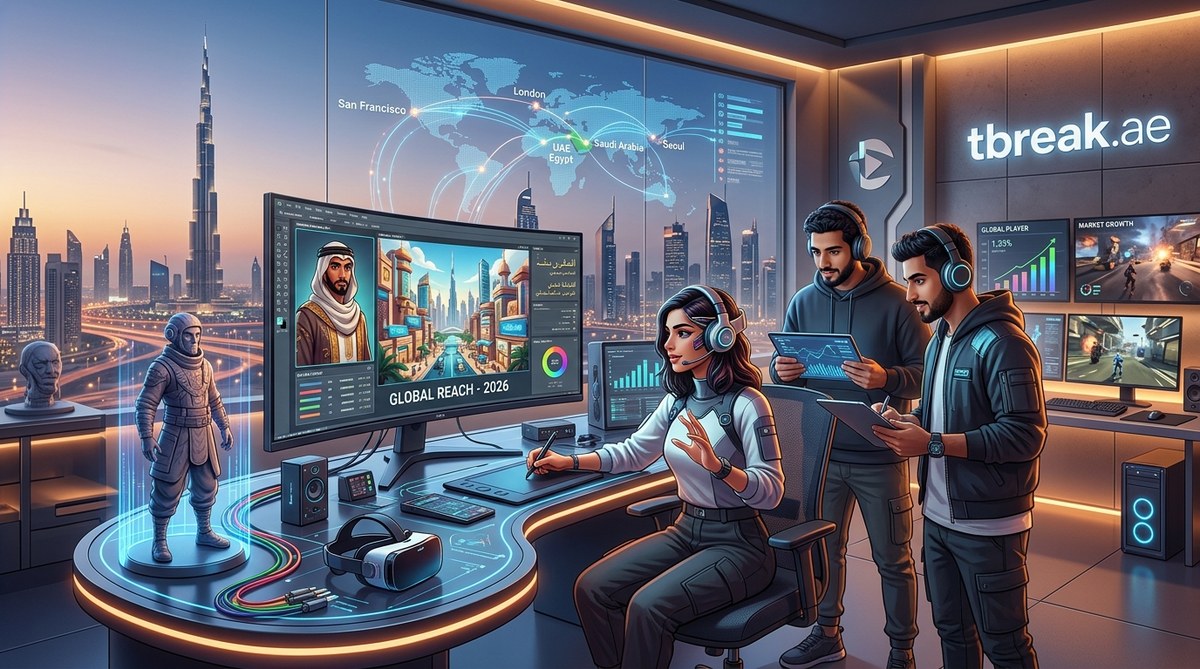
How Middle Eastern Game Developers Are Shaping the Global Industry in 2026
The video game landscape looks different in 2026. A decade ago, the Middle East was mostly a consumer market for games made in the West or East. Today, studios from Riyadh to Dubai to Cairo are shipping titles that compete on storefronts alongside the biggest names. They are not just translating existing games into Arabic anymore. They are building original worlds rooted in Middle Eastern mythology, history, and everyday life, and the rest of the industry is taking notes.
Middle East game developers in 2026 are driving global trends through culturally authentic storytelling, mobile-first innovation, and government-backed infrastructure. Studios are creating original IPs that resonate with a massive Arabic-speaking audience while attracting international publishers. The region’s unique mix of youthful demographics, high smartphone penetration, and strategic investments positions it as a rising powerhouse that investors and partners can no longer ignore.
From Localization to Original IP
For years, “Middle Eastern gaming” meant a big publisher slapping Arabic subtitles on a hit from Japan or the US. That era is over. In 2026, developers in the region are creating fresh intellectual property that draws from local folklore, regional history, and modern Gulf life.
Take Semaphore, a studio based in Kuwait. Their title “The Tale of the Lost Sands” is a puzzle adventure set in an ancient South Arabian kingdom. The game uses traditional geometric patterns and voice acting in both Arabic and English. It sold over 200,000 copies in its first month on Steam, with 40% of those sales coming from outside the Middle East. That is a clear sign that global players want more than just another medieval fantasy or sci-fi shooter.
Similarly, Tamatem Games, based in Amman, Jordan, has built a mobile empire by serving the Arabic-speaking audience with games like “Fashion Queen” and “Battle of the Alliance.” But in 2026, they are expanding with original narrative titles that mix Arabic humor with gameplay mechanics that work on mid-range devices. Their latest release, “Sheikh’s Adventure,” climbed to number three on the UAE Google Play store within a week.
Why Global Studios Are Paying Attention
The influence is not one way. Major Western and Asian publishers are actively courting Middle Eastern talent. Microsoft opened a dedicated game development center in Abu Dhabi in 2025, and in 2026 it doubled the team size to 150 people. The focus is on creating games that reflect the region’s culture while also feeding into global franchises like Forza and Age of Empires.
Ubisoft’s Abu Dhabi studio, which has been around since 2019, now plays a key role in the Assassin’s Creed franchise. The team there handled much of the world design for the Mira region in a recent entry. Ubisoft has also invested in a local incubator program that has so far helped seven indie studios get their first games published.
What makes these studios attractive to global partners?
- Cost-effective talent. Average developer salaries in the Middle East are lower than in San Francisco or London, but the quality of training from programs like SAW (Saudi Arabian Federation for Electronic and Intellectual Sports) and the UAE’s twofour54 is rising.
- Cultural insight. A team in Riyadh knows how to make a game that feels genuine to a Saudi teenager. That authenticity sells, both locally and to the diaspora.
- Government funding. Saudi Arabia’s PIF (Public Investment Fund) has invested heavily in gaming through the Savvy Games Group. This means studios have capital to take risks on original ideas that would struggle to get funded in Silicon Valley.
Mobile First, Mobile Everywhere
One of the biggest ways Middle East game developers are shaping the global industry is through mobile gaming. The region has one of the highest smartphone penetration rates in the world. In 2026, over 85% of people in the GCC own a smartphone, and a huge chunk of that audience plays games daily.
Middle Eastern developers have become experts at building games that run smoothly on older hardware while still looking impressive. This skill set is now in demand worldwide as emerging markets in Africa, Latin America, and Southeast Asia grow their player bases. A studio in Cairo that learned to optimize a Unity engine game for a phone with 3GB of RAM can teach a lot to a studio in Stockholm trying to reach players in Nigeria.
A few standout examples:
- GigaMiki in Egypt created “Miki’s World,” a battle royale that runs on devices with 2GB of RAM and uses regional characters like a falcon trainer and a dhow captain. The game has over 10 million downloads across the Middle East and Africa.
- Boss Bunny Games in Riyadh focuses on hyper-casual games with Middle Eastern themes. Their game “Carpet Flyer” became a top 10 download in India and Brazil in early 2026.
- Falcon Interactive in the UAE builds mobile sports simulators. Their cricket and football games are huge in Pakistan and Bangladesh, and they recently signed a deal to publish a title for the Asian Games.
The Indie Scene: Small Teams, Big Impact
Not every Middle Eastern developer works at a big studio. The indie scene is thriving, helped by local game jams and online distribution. Platforms like Itch.io and Steam have made it possible for a team of three people in Beirut to reach players in Tokyo or Berlin.
Consider the case of “Wings of the Sphinx,” a 2D platformer created by a five-person studio called Nile Collective in Cairo. The game uses mechanics inspired by ancient Egyptian board games and tells a story about a young priest who must restore balance. It won Best Indie Game at the Global Games Show in Riyadh in 2026. The developers funded it through a combination of a government grant from Egypt’s Ministry of Communications and a successful Kickstarter that raised $150,000.
Another example is “Souk Racer,” a kart racing game set in a lively market. The team, based in Jeddah, used procedurally generated stalls and traffic to keep each lap fresh. It was picked up by a Chinese publisher for release across Asia.
The indie community is also organizing. Events like the MENA Game Developers Summit and the Dubai Indie Dev Meetup are happening monthly in 2026. These gatherings connect coders, artists, and writers who might otherwise work in isolation. The result is a steady stream of experimental titles that push boundaries.
Government Support: The Structural Advantage
It is impossible to talk about Middle East game developers in 2026 without mentioning the role of government money. Saudi Arabia’s Vision 2030 explicitly names gaming and esports as a pillar of economic diversification. The country has invested billions through Savvy Games Group, which now owns stakes in major companies like EA, Take-Two, and Activision Blizzard. But more importantly, it has funded local development directly.
The Saudi Game Dev Fund, launched in 2023, has already backed over 40 studios. In 2026 alone, it distributed $50 million in grants and interest-free loans. The fund requires that at least 70% of the team be Saudi nationals, which is forcing a pipeline of training and education. Universities in Riyadh and Jeddah have doubled their game design enrollment over the past two years.
The UAE is following a similar path. Abu Dhabi’s Creative Media Authority offers tax breaks and co-working space for studios that set up in the city. Dubai’s Internet City hosts over 60 game studios, up from 20 in 2022. The result is a competitive but collaborative ecosystem where studios can share resources and talent.
Here is a breakdown of the key government initiatives and their impact in 2026:
| Initiative | Country | Focus | Impact |
|---|---|---|---|
| Savvy Games Group | Saudi Arabia | Investment + Publishing | $8B fund, stakes in global publishers, 25 local studios backed |
| Saudi Game Dev Fund | Saudi Arabia | Local indie grants | $50M in 2026, 40+ studios supported, 70% local hiring rule |
| twofour54 Gaming Hub | UAE | Incubation + Infrastructure | 60+ studios, co-working, tax incentives, pitch events |
| Qatar Gaming District | Qatar | Esports + Development | Arena + studio space, partnered with ESL FACEIT Group |
| Egypt’s ICT Grants | Egypt | Indie seed funding | $10M for 2026, 30% of funds reserved for women-led teams |
These numbers matter because they create a safety net for developers. When a studio in Seattle might fold after one failed launch, a studio in Riyadh can fall back on grant money and government connections. That resilience lets them take creative risks.
Cultural Storytelling That Travels
Middle Eastern developers are also changing what stories get told in games. For years, the Middle East was often depicted in Western games as a battlefield or a desert backdrop. Now, local teams are telling their own stories with nuance.
“Salt of the Earth,” a farming and life simulation game from a studio in Bahrain, shows a coastal village where players manage a date palm farm and a fishing boat. The game includes prayer times that adjust based on the player’s real-world location, and it has a system for fasting during Ramadan that rewards patience. It became a surprise hit in Turkey, Indonesia, and Malaysia, markets where similar cultural touch points exist.
This kind of cultural specificity is a competitive advantage. Players everywhere are tired of generic settings. A game that feels genuinely rooted in a place and a culture can stand out in a crowded market.
Esports and the Competitive Edge
The esports scene is another avenue where Middle East developers are making their mark. Saudi Arabia’s Gamers8 festival and the Global Games Show have become major stops on the international circuit. But local developers are also building games specifically designed for competitive play.
“Oasis Arena,” a 3v3 hero brawler from a studio in Riyadh, launched in early 2026. It features characters inspired by historical figures from the Islamic Golden Age, like a mathematician who throws geometric projectiles and a poet who buffs teammates with verses. The game already has a professional league in the Middle East with prize pools of $500,000. Riot Games and Blizzard are reportedly in talks with the studio about a global publishing deal.
Middle Eastern esports teams have also started their own development arms. Team Falcons, one of the region’s biggest esports organizations, opened a game studio in Abu Dhabi in 2025. Their first project is a tactical shooter set in a futuristic Doha. The team is using player data from their competitive rosters to balance weapons and maps.
The Hardware and Infrastructure Push
You cannot shape the global industry without the tools to do it. Middle Eastern developers are benefiting from massive investments in cloud infrastructure and data centers. Saudi Arabia’s NEOM is building a dedicated gaming campus with a render farm that local studios can access for free. The UAE’s G42, an AI and cloud company, offers subsidized server time for game developers.
This infrastructure helps with things that used to be barriers: running playtests, hosting multiplayer servers, and rendering high quality cinematics. In 2026, a small team in Dubai can access the same computational power as a team at a major publisher.
How to Evaluate a Middle East Game Developer for Investment
For industry analysts and investors, the question is how to spot the studios that will make it globally. Here is a practical framework.
- Check the team’s cultural authenticity. Does the game misrepresent or stereotype, or does it show genuine depth? Look for teams with diverse local voices, not just expat hires.
- Assess their technical optimization. Ask to see performance tests on older Android phones. If a game runs smoothly on a Galaxy A series, it has transferable skills for other emerging markets.
- Review their funding history. Studios with government grants or strategic VC from regional funds (like Savvy or Shorooq Partners) are less likely to run out of cash mid-development.
- Look at their localization strategy. The best Middle Eastern developers plan for English, Turkish, and Urdu versions from day one, not as afterthoughts.
- Monitor community engagement. Check their Discord or social media. Studios that actively listen to Arabic-speaking players often build loyal fanbases that follow them to new platforms.
- Examine their esports pipeline. If they are building competitive games, do they have ties to events like Gamers8 or the Global Games Show? Those connections provide visibility and prize money.
These steps help separate studios with short-term hype from those with sustainable models.
The Road Ahead for Global Partnerships
The shift is not just about volume. It is about influence. In 2026, a game designed in Jeddah influences how a studio in Montreal thinks about weather systems. A narrative written in Cairo changes how a writer in Los Angeles approaches dialogue.
Partnerships are also evolving. Traditional co-development deals where a Middle East studio handles asset production are giving way to true co-ownership of IP. The region’s developers are asking for a seat at the table, and they are getting it. For example, the upcoming action RPG “Sands of Night” is a joint venture between a Saudi developer and a Polish studio, with both sides sharing the trademark and royalties.
This is the moment to take Middle Eastern developers seriously as creators, not just outsourcers. The region produces games that appeal to a massive, underserved audience of Arabic speakers, but also to global players hungry for fresh perspectives.
Where Middle East Game Developers Are Headed Next
The growth shows no signs of slowing. By 2030, the Middle East gaming market is expected to exceed $45 billion, and local developers will capture a growing slice of that. We are already seeing the first wave of Middle Eastern studios opening offices in Europe and North America, not the other way around.
For anyone in the gaming business, the message is clear. Pay attention to the games coming out of the Middle East. Play them. Partner with their creators. And if you are an investor looking for the next breakout hit, consider that the next big IP might be born in a co-working space in Dubai or a university lab in Riyadh.
The industry used to think of the Middle East as a market. Now it is a workshop.
Check out our guide to the best gaming laptops under 5000 AED available in the UAE and Saudi Arabia if you want to upgrade your rig to play these titles. For a deeper look at the region’s esports growth, read how Middle Eastern esports teams are competing on the global stage in 2026. And if you are curious about the hardware powering it all, see our analysis of why the Middle East gaming market is outpacing global growth in 2026.
The next chapter of gaming is being written in Arabic, and the whole world is reading along.

Post Comment