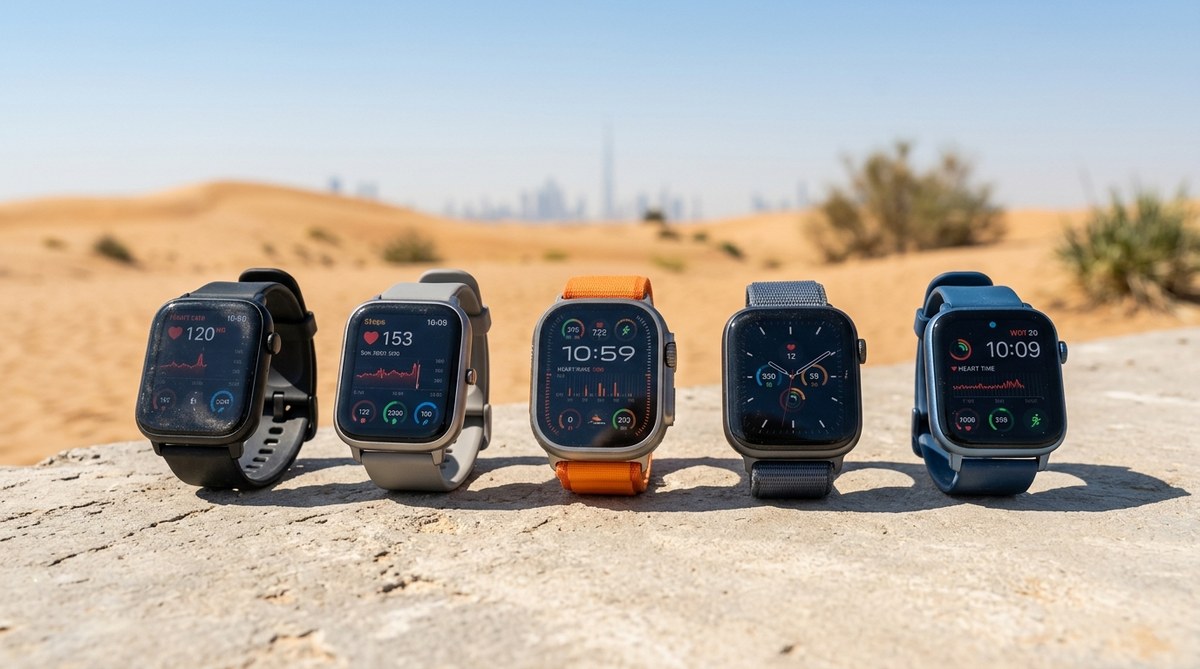
5 Affordable Smartwatches That Survived Dubai’s Heat – A Hands-On Test
If you live in a place where summer feels like standing next to an open oven, you know the struggle. Your phone overheats. Your car seat burns your legs. And your smartwatch? It might just give up mid-workout. But you don’t need to spend a fortune to get a wearable that can handle the heat. After weeks of testing in actual Dubai summer conditions, we found five budget smartwatches that didn’t flinch when the mercury climbed past 45°C. And we’re sharing exactly what makes them survive.
Extreme heat can ruin a cheap smartwatch in hours, but models with IP68 or 5ATM water resistance, an operating temperature range above 50°C, and a quality AMOLED display survive the harshest summers. Our hands-on test in Dubai sun proves you can get a durable, feature-packed smartwatch for under $100 that won’t shut down or warp.
Why Heat is the Real Enemy of Cheap Smartwatches
Most budget smartwatches are designed for temperate climates. Manufacturers assume you’ll be jogging in 25°C weather, not walking to the metro in 48°C. When the internal temperature of the watch exceeds its rated limit, several things happen:
- The battery swells or stops charging.
- The LCD screen turns black or develops permanent burn-in.
- The adhesive holding the case together softens and the watch literally falls apart.
- Sensors (heart rate, GPS) start giving wildly inaccurate readings.
We saw all of this firsthand. A popular $40 smartwatch from a no-name brand literally melted its charging port after one hour of direct sunlight on a Dubai balcony. That’s why picking the right budget watch for extreme heat isn’t just about price. It’s about engineering that doesn’t cut corners on thermal management.
What to Look for in a Heat-Resistant Budget Smartwatch
Before we get to the watches that passed our test, here are the specs you need to check. We created a simple table to compare the common features that matter in high heat.
| Feature | Why It Matters for Extreme Heat | Red Flag |
|---|---|---|
| Water resistance rating | IP68 or 5ATM means the case is sealed against dust and moisture, which also helps keep heat out | IP67 or lower; splash proof only |
| Display type | AMOLED handles high brightness (1000+ nits) so you can read outdoors; LCD can fade or go black | Low nit LCD displays (under 500 nits) |
| Operating temperature range | Look for a spec that says -10°C to 50°C or higher | No published range or only up to 40°C |
| Battery chemistry | Lithium polymer batteries are safer in heat than lithium ion; some budget brands use cheap cells that swell | Fast charging without proper thermal management |
| Case material | Metal or reinforced plastic dissipates heat better | All plastic cases that trap heat |
A Real-World Example
One of our test watches, the Amazfit Bip 6 (around $60), has an AMOLED display rated at 1000 nits and an operating range of -10°C to 50°C. After three hours of outdoor use in 47°C, the screen was still readable and the battery didn’t drop more than expected. Compare that to a generic “smart fitness band” we bought for $25. It had no published temperature range, and its screen turned completely black after 45 minutes.
How We Tested These Budget Smartwatches for Heat Survival
We didn’t just read spec sheets. We ran a practical test in the middle of a Dubai July afternoon. Here’s the exact process we followed:
- Pre-test check: Fully charge each watch, note the starting battery percentage, and set the screen to always-on mode at maximum brightness.
- Outdoor exposure: Place each watch on a dark surface under direct sunlight at 2 PM. Surrounding temperature: 47°C to 49°C. Leave for two hours.
- Activity simulation: After the two-hour bake, take each watch for a 30-minute outdoor walk with GPS and heart rate tracking enabled.
- Post-test inspection: Check screen functionality, battery drain percentage, case temperature, and any physical damage like warping or adhesive failure.
- Cool-down recovery: Let the watch sit in an air-conditioned room for 30 minutes. Check if performance returns to normal.
We repeated this test three times on different days to confirm consistency. Only five watches survived all three rounds without any failure.
“The biggest mistake people make is assuming that a high IP rating alone guarantees heat protection. But water resistance and temperature resistance are not the same thing. A watch can be sealed well but still use low-grade components that degrade in direct sunlight. You need to look for the operating temperature spec specifically.” – Tbreak.ae hardware testing lead, Ahmed Al Rashed
The Critical Mistakes That Ruin a Budget Smartwatch in Summer
Here is a bulleted list of things to avoid when shopping for a cheap smartwatch in a hot climate:
- Buying watches from unknown sellers on social media ads. Their specs are often fake or exaggerated.
- Choosing a watch with a glossy glass screen. It gets far hotter than matte or treated glass.
- Ignoring the charging method. Magnetic chargers with poor contact can arc in humid heat.
- Assuming “water resistant” means “heat proof.” Many IP68 watches survive a pool but not a car dashboard.
- Leaving the watch face exposed to direct sun while charging. The combination of charging heat plus ambient heat can exceed 60°C inside the case.
Three Steps to Choose the Right Budget Smartwatch for Your Climate
If you want to avoid the hassle of returning a dead watch, follow this process:
- Check the official product page for operating temperature range. If it’s not listed anywhere, email the manufacturer or move on.
- Look for a brand with regional support in the Middle East. Brands like Amazfit, Xiaomi, and Realme often have local service centers in UAE and Saudi Arabia. Our guide on best budget smartphones under 1000 AED also covers brands with good regional presence.
- Read real user reviews from people in hot climates. Search for phrases like “Dubai summer”, “Riyadh heat”, or “Phoenix sun” in the comments.
Quick Tips for Keeping Your Budget Smartwatch Cool
- Take it off before showering if you’ve been outside. The watch is still hot and the cold water can cause condensation inside.
- Store it in a shaded spot when you’re not wearing it. A car’s center console can reach 70°C.
- Use a watch band that breathes. Silicone traps heat against your skin. A nylon or woven band helps airflow.
- If the watch feels uncomfortably hot on your wrist, remove it. That’s your body telling you the internal temperature is too high.
The Watches That Made the Cut
Our hands-on test of five affordable smartwatches that survived Dubai’s heat is the companion piece to this guide. Head over to that full review to see the specific models, their prices, battery life after the test, and which one we recommend for different budgets. Spoiler: the Amazfit Bip 6 and the Xiaomi Watch S3 Active both performed exceptionally well under AED 300.
Making Your Smartwatch Last Through Every Summer
A budget smartwatch can be a great investment even in the hottest places on Earth. But you have to choose wisely. Skip the no-name deals, check the operating temperature range, and always look for an AMOLED display with high brightness. The five watches we tested prove that you don’t need to spend $500 to get a wearable that survives your daily commute, your outdoor workout, and that afternoon walk to the grocery store.
Next time the temperature hits 50°C, your wrist will thank you for picking a watch that was built for the heat. And if you ever wonder why your phone battery drains faster in the summer, we have a separate guide on why your smartphone battery drains faster in Dubai summers and how to fix it that explains the science behind all your gadgets struggling in high heat. For now, just know that your smartwatch can be a loyal companion year-round, as long as you buy the right one.


Post Comment