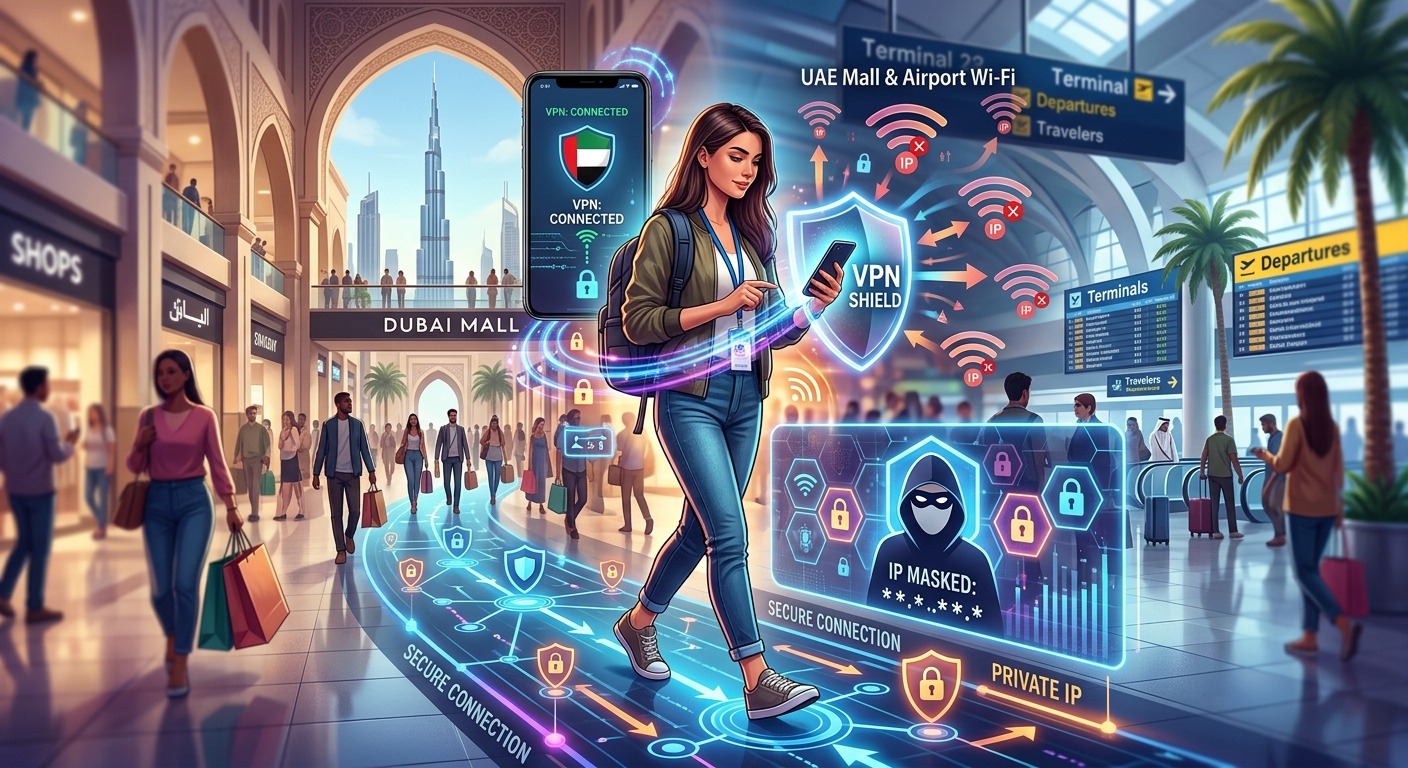
How to Use UAE Mall and Airport Wi-Fi Without Exposing Your IP
You tap “DXB Free WiFi” at the airport gate and your phone connects before you even look up from your screen. Nobody warned you that your device just broadcast its IP address to every router, log server, and packet sniffer within range. That split-second connection is all it takes for your digital fingerprint to land on someone else’s database.
This is not a hypothetical. Public Wi-Fi in the UAE, including the free networks at Dubai Mall, Dubai International Airport, Abu Dhabi’s Yas Mall, and hotel lobbies across the country, runs on shared infrastructure. Every device on that network can, in theory, read traffic from every other device. Your IP address does not stay private by default.
What You Need to Know Before You Connect
- Public Wi-Fi networks expose your IP address to other users and network operators by default.
- Your IP can be used to target you with ads, track your approximate location, or build a behavioral profile over time.
- Man-in-the-middle attacks on open networks can intercept unencrypted traffic even on familiar-looking networks.
- Gamers at cafes or regional LAN events face added risk because their real IP can be weaponized to disrupt a match.
- Hiding your IP before connecting is a concrete, immediate first step toward protecting your privacy on any shared network.
Why Your IP Address Reveals More Than You Expect
Your IP address is not just a technical identifier. It is a tag attached to every request your device makes online. Websites read it to serve region-specific content. Advertisers use it to build behavioral profiles. And on a public network, other users on the same connection can potentially see it if the right tools are running.
In the UAE, where mobile internet penetration is among the highest in the world, your IP address is often tied to your ISP, your approximate location down to the neighborhood level, and your device type. A targeted ad showing you a product from a store you walked past twenty minutes ago is not magic. That kind of tracking starts with your IP.
Here is what someone with access to your IP address can typically do:
- Determine your approximate physical location, sometimes accurate to within a few kilometers.
- Identify your ISP and the type of connection your device is using.
- Build a browsing history profile when your IP is combined with ad network tracking data.
- Attempt a targeted connection flood to disrupt your session if they want to cause damage.
- Log your activity for later analysis or sell it to data broker networks operating across borders.
What Open Networks at Dubai Mall and DXB Actually Do With Your Data
Dubai Mall’s free Wi-Fi handles tens of thousands of devices on a single busy day. The airport is even more congested. These networks are not monitored individually for each user’s personal safety. They are managed for uptime and capacity, not for your privacy.
When you connect to a public network, your device sends out network packets that include your IP address as part of every communication. Any other device on the same subnet can capture those packets using freely available software. This is called packet sniffing, and it requires no special hardware beyond an ordinary laptop.
Some attackers take it further. They create what looks like a legitimate Wi-Fi network using a name like “Dubai Mall Free WiFi” or “DXB Lounge WiFi.” You connect thinking it is the official network. Instead, you are on a rogue hotspot, and everything you send passes through the attacker’s machine first. This is precisely what makes a man-in-the-middle attack so effective: the attacker can read, alter, or log your traffic without you ever knowing it happened.
The Hotel Lobby Problem
Hotel networks in the UAE follow a similar pattern. The lobby Wi-Fi at a five-star property might look more polished than a mall hotspot, but it runs on the same principle. Guests, staff, and sometimes walk-in visitors all share the same network. There is rarely end-to-end encryption between your device and the hotel’s router unless you bring your own protection to the table.
If you are checking your bank app or logging into any account on that network without securing your connection first, your session data is potentially visible to anyone watching the traffic on that shared subnet.
Why Gamers at UAE Cafes Face a Specific Threat
Anyone who follows the UAE gaming scene knows this setup: you are at a gaming cafe in Deira or Al Barsha, locked into a ranked match, and the last thing on your mind is network security. That is exactly when it matters most.
Gaming on a shared public network exposes you to something beyond typical browsing risks. When your real IP address is visible to others on the network, or to players in your game lobby, you become a target for a DDoS attack. A player who wants to knock out competition can flood your connection with junk traffic, spiking your latency mid-match or disconnecting you entirely.
At a regional tournament or a cafe LAN session, that is not just frustrating. It is a competitive disadvantage with real consequences. Protecting your IP means nobody on the opposing team or the same cafe network has a direct path to disrupt your connection when it matters.
The fix takes under a minute. Before you sit down at any shared network for a gaming session, mask your IP so you start the match without handing anyone a lever they can use against you mid-game.
The Quieter Risk: Data Brokers and Long-Term Profiling
Beyond the immediate threat of another person on the same network, there is a slower and more persistent problem most people never think about. Data brokers collect IP-linked browsing data from networks all over the world, including from ad networks embedded in the apps and websites you visit in public spaces.
Every time your IP address makes a request to a page that runs third-party tracking scripts, that activity gets logged. Over time, a profile builds. Your rough location, the times you browse, the categories of content you visit, your device type. None of this needs to be tied to your name to be valuable. The profile is specific enough to target you effectively across multiple platforms for months or years.
In the UAE, where consumers are increasingly aware of how personal data moves across international borders, this kind of passive collection is worth taking seriously. It does not require a hacker sitting near you. It just requires that you connect to a network running advertising infrastructure without any protection.
A Practical Plan to Stay Private on UAE Public Networks
The steps below work whether you are at DXB waiting for a flight, grabbing a coffee at a mall food court, or competing at a local gaming event:
- Check your current IP before connecting. Know what your device is broadcasting so you can verify your protection is working once it is active.
- Mask your IP before touching any public network. Make this a pre-connection habit, not a reaction to feeling unsafe after the fact.
- Disable auto-connect for saved network names. Your phone remembers “Dubai Mall WiFi” and reconnects silently the next time it sees that name, even if a rogue hotspot is using the same name nearby.
- Use HTTPS-only mode in your browser. Most modern browsers support this setting. It prevents your device from loading unencrypted pages, which are the easiest for attackers to intercept and read.
- Avoid sensitive accounts on public networks entirely. Banking apps, corporate email, and anything with saved payment data should wait until you are on a trusted, private connection.
Risk Levels Across Common UAE Public Network Types
| Network Type | Password Required | IP Exposure Risk | Rogue Hotspot Risk |
|---|---|---|---|
| Airport (DXB / AUH) | Sometimes | High | High |
| Shopping Mall | Rarely | High | Medium |
| Hotel Lobby | Usually (voucher) | Medium | Low |
| Gaming Cafe | Yes | Medium | Low |
| Coffee Shop | Sometimes | High | Medium |
Small Habits That Change Your Risk Profile Right Away
You do not need to understand every layer of how TCP/IP works to protect yourself on a public network. The core idea is simple: hide your real IP address before you connect to any network you do not fully control.
A few habits worth building right now:
- Treat every public Wi-Fi connection the same way you would treat a stranger handing you a USB drive: with caution, not automatic trust.
- On your phone, go into Wi-Fi settings and enable “random MAC address” if the option exists. This adds another layer of anonymity by rotating your device’s hardware identifier on shared networks.
- Pass these habits on to family members, especially children who use public Wi-Fi at malls. They are just as exposed and far less likely to realize it.
- Keep IP masking active as a default behavior, not just when something feels off. By the time something feels suspicious, the exposure has already happened.
The technology to protect yourself here is not complicated. The barrier is usually awareness. Most people across the UAE have no idea what happens when they connect to a public network because nothing obviously bad happens immediately. The tracking is quiet. The data collection is invisible. The rogue hotspot looks exactly like the real one. That is what makes it work.
The Connection You Actually Control
Everything discussed here applies equally to your laptop, your phone, and your tablet. If a device connects to the internet and you are not on your home network or a trusted private connection, your IP address is potentially visible to others sharing that infrastructure.
Building a habit around IP privacy in public spaces is not paranoia. It is the kind of routine that becomes second nature once you understand what is at stake. You lock your car even in a safe neighborhood. You put a PIN on your phone even though nothing bad has happened yet. Protecting your IP before connecting at the airport, the mall, or the gaming cafe belongs in that same category of simple, sensible behavior.
The UAE is one of the most connected countries in the world. High smartphone penetration, constant travel through major international hubs, and a culture of staying online everywhere means the average person here connects to more public networks in a single week than most people do in a month. That frequency raises your exposure in ways most people never stop to consider.
Take the one step that changes your risk profile right now. Before your next connection at any public spot in Dubai or Abu Dhabi, check how visible you are and act accordingly. Your digital activity in the UAE deserves the same care you give to everything else you keep private.



Post Comment