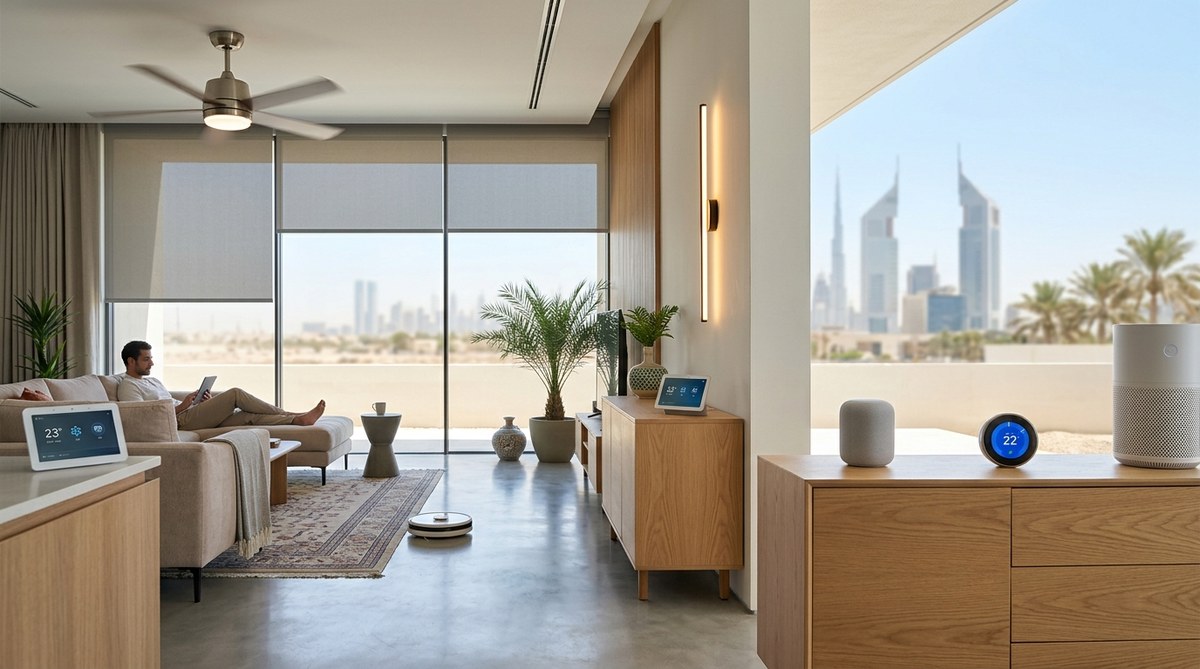
Ultimate Guide to Smart Home Devices That Thrive in Middle Eastern Climates
You just spent a small fortune on a smart thermostat for your villa in Dubai, only to have it overheat and disconnect by noon. Or maybe your robot vacuum choked on construction dust within a week. You are not alone. The Middle East presents a set of challenges that most global tech companies simply do not test for. Extreme heat, fine dust, high humidity near the coast, and the unique construction materials used in regional homes can destroy standard smart home gadgets. This guide cuts through the marketing fluff. We focus on the devices that actually survive and thrive in the UAE, Saudi Arabia, and Qatar.
To build a smart home in the Middle East that works year round, prioritize devices with an IP rating for dust and water, look for an operating temperature range that exceeds 50 degrees Celsius, and invest in a mesh WiFi system designed for concrete and steel construction. Avoid cheap plastic enclosures and stick to brands with local warranty support.
What Makes the Middle East a Tough Environment for Smart Tech
The numbers tell the story. In Riyadh, summer temperatures regularly hit 50 degrees Celsius. In Abu Dhabi, humidity can hover above 80 percent for weeks. Then there is the dust. Fine sand particles from the Empty Quarter can infiltrate a device’s vents and ports, causing overheating and mechanical failure. Many popular smart home brands design their products for temperate climates in Europe or North America. A device that works fine in Seattle will likely fail in Sharjah.
Another overlooked factor is home construction. Most villas and apartments in the region use reinforced concrete, steel beams, and double brick walls. These materials create a nightmare for WiFi signals. A standard router from a US retailer often cannot penetrate a single concrete wall, let alone cover a full floor. This means your smart lock or camera loses connection constantly. You need hardware built for this reality.
The Three Pillars of a Climate Ready Smart Home
Before you buy anything, check these three specs on every product.
- Operating temperature range. Look for a device rated to work at 50 degrees Celsius or higher. Many cheap sensors only work up to 40 degrees.
- Ingress Protection (IP) rating. For outdoor cameras or sensors, you want at least IP65. This means it is dust tight and can handle water jets. For indoor units, IP54 is a good baseline.
- Local warranty and support. If a device fails under the summer sun, you want a local distributor in the UAE or Saudi Arabia who will replace it. International warranties often require you to ship the product abroad.
Smart Hubs and Bridges That Handle the Heat
Your smart home hub is the brain of the operation. If it crashes, everything goes silent. Many popular hubs have plastic casings and passive cooling that cannot handle a 45 degree room temperature.
Look for hubs with metal enclosures or built in fans. The Hubitat Elevation is a solid choice because it processes everything locally, reducing reliance on cloud servers that can lag. For those using Apple products, the Hubitat also works well. Another option is the Aqara Hub M2. It has a sturdy build and supports Zigbee and Matter protocols. Matter is especially useful in 2026 because it allows devices from different brands to talk to each other without needing separate apps.
Do not forget to place your hub in a cool, shaded spot. Avoid putting it near a window or in a kitchen where heat from cooking can spike the ambient temperature.
Cooling and Climate Control That Actually Saves Money
Everyone in the Middle East knows the AC bill is a monthly monster. Smart thermostats can help, but only if they are designed for split AC units. Most US style smart thermostats are designed for central HVAC systems, which are rare in Gulf villas.
You need a smart AC controller that works with your existing split unit. The Sensibo Sky is a regional favorite. It attaches to your remote control and lets you manage the AC from your phone. It also supports geofencing, so the AC turns off when you leave the house. The Ambi Climate 2 is another strong option. It uses AI to learn how your home retains heat and adjusts the temperature automatically. Both devices are tested to work in high heat.
For whole home control, consider the Tado V3+ system. It works with ducted AC systems common in larger villas. It includes wireless temperature sensors that you can place in different rooms. This helps balance cooling across the house.
Security Cameras and Doorbells Built for Dust
Outdoor security cameras face the worst conditions. Direct sunlight, sandstorms, and sudden downpours. The camera lens can fog up, and the internal battery can swell in extreme heat.
The Reolink Argus 4 Pro is a strong contender. It has an IP67 rating, meaning it is fully dust tight and can be submerged in water. It uses a weatherproof solar panel to charge, so you do not need to run wiring. Another excellent choice is the EufyCam 3. It offers 4K resolution and local storage. The battery life is impressive, often lasting six months or more in moderate use.
For a video doorbell, the Ring Video Doorbell Pro 2 works well, but you must buy the version sold in the UAE market. The US version may not connect properly to local networks. The Google Nest Doorbell (battery version) is also reliable, but mount it under a covered porch to keep it out of direct sunlight.
Robot Vacuums That Do Not Choke on Sand
Standard robot vacuums struggle with the mix of fine dust, sand, and marble floors common in the region. The sand can clog the filter within days, and the rubber brushes can wear down.
The Roborock S8 Pro Ultra is the current champion for Middle Eastern homes. It has a self emptying dock that uses a strong suction system to clear the dustbin. The rubber brush is designed to handle sand without tangling. It also supports mopping, which is essential for dealing with dust residue on marble.
Another option is the Ecovacs Deebot X2 Omni. It has a square front that lets it clean corners better. The navigation system uses lidar, which works well in low light. Both models have filters that are easy to remove and clean. Plan to wash the filter every two weeks during summer.
Smart Lighting That Survives the Sun
Outdoor smart lights need to handle direct UV exposure and high heat. Plastic housings can become brittle and crack. Look for lights with aluminum or stainless steel bodies.
The Philips Hue outdoor range is a safe bet. The bulbs have a metal heat sink that dissipates heat effectively. The Lily XL spotlights are great for gardens. For indoor lighting, the Ikea Trådfri system offers good value. The bulbs are affordable and connect to most smart hubs.
Avoid cheap LED bulbs from unknown brands. They often fail within months in the region. Stick to brands with a local presence.
How to Choose the Right Mesh WiFi System
This is the most important purchase you will make. Without a strong network, no smart device works.
| Feature | Standard Router | Mesh WiFi System |
|---|---|---|
| Concrete wall penetration | Poor, often drops signal | Excellent, uses multiple nodes |
| Coverage for a 3BR villa | Covers 1 floor partially | Covers all floors and yard |
| Device handling | Struggles with 10+ devices | Handles 50+ devices easily |
| Heat tolerance | May throttle in high heat | Built with better ventilation |
| Local support | Limited | Available in UAE and KSA |
The TP-Link Deco X90 is a top pick for 2026. It supports WiFi 6, which offers better range and speed. The three pack can cover a 5,000 square foot villa easily. Another strong option is the Netgear Orbi RBK853. It has a dedicated backhaul channel that keeps speeds high even when many devices are connected.
Place one node near your smart home hub and another in a central hallway. This ensures your devices stay connected.
A Step by Step Plan to Set Up Your Smart Home
Follow these steps to avoid common mistakes.
- Start with the network. Install your mesh WiFi system first. Test the signal strength in every room. Move nodes until you have full coverage.
- Choose your hub. Set up your smart hub and connect it to the network. Update the firmware before adding devices.
- Install climate control. Set up your smart AC controller. Program your schedule and geofencing settings.
- Add security. Mount cameras and doorbells in shaded spots. Test the night vision and motion detection.
- Set up lighting. Replace key bulbs with smart bulbs. Focus on outdoor lights and living room lamps first.
- Deploy the robot vacuum. Let it map your home. Set no go zones for areas with loose cables or delicate furniture.
- Automate routines. Create simple routines. For example, when you leave home, turn off all lights and set the AC to eco mode.
Expert Advice on Maintenance
“The biggest mistake I see homeowners make is forgetting to clean their devices. Dust accumulation is the number one killer of smart home tech in the region. Set a monthly reminder to wipe down camera lenses, vacuum the hub vents, and check the AC controller for dust buildup. A can of compressed air is your best friend.” – Ahmed Al Mazrouei, Smart Home Installer based in Abu Dhabi
Common Mistakes to Avoid
- Buying the international version of a device. Always check that the product is certified for the UAE or Saudi Arabia. The radio frequencies and power standards can differ.
- Ignoring the IP rating. If a camera is not rated for dust, it will fail.
- Using a single router. Concrete walls will kill your signal. Spend the money on mesh.
- Mounting devices in direct sunlight. Even rugged devices last longer in shade.
- Skipping surge protectors. Power fluctuations are common during summer storms. Protect your gear.
Your Smart Home, Built to Last
The Middle East does not have to be a hostile place for your smart home. You just need to choose the right tools for the job. Focus on devices with high IP ratings, wide operating temperature ranges, and local support. Invest in a solid mesh network first. Then build out your climate control, security, and lighting systems step by step.
Remember that maintenance is not optional. A few minutes each month spent on cleaning and software updates will save you hours of frustration later. The payoff is a home that stays cool, secure, and efficient, even when the mercury hits 50 degrees.
Now go ahead and check the specs on your next purchase. Your future self, sitting in a perfectly cooled living room with lights that dim on command, will thank you.


Post Comment