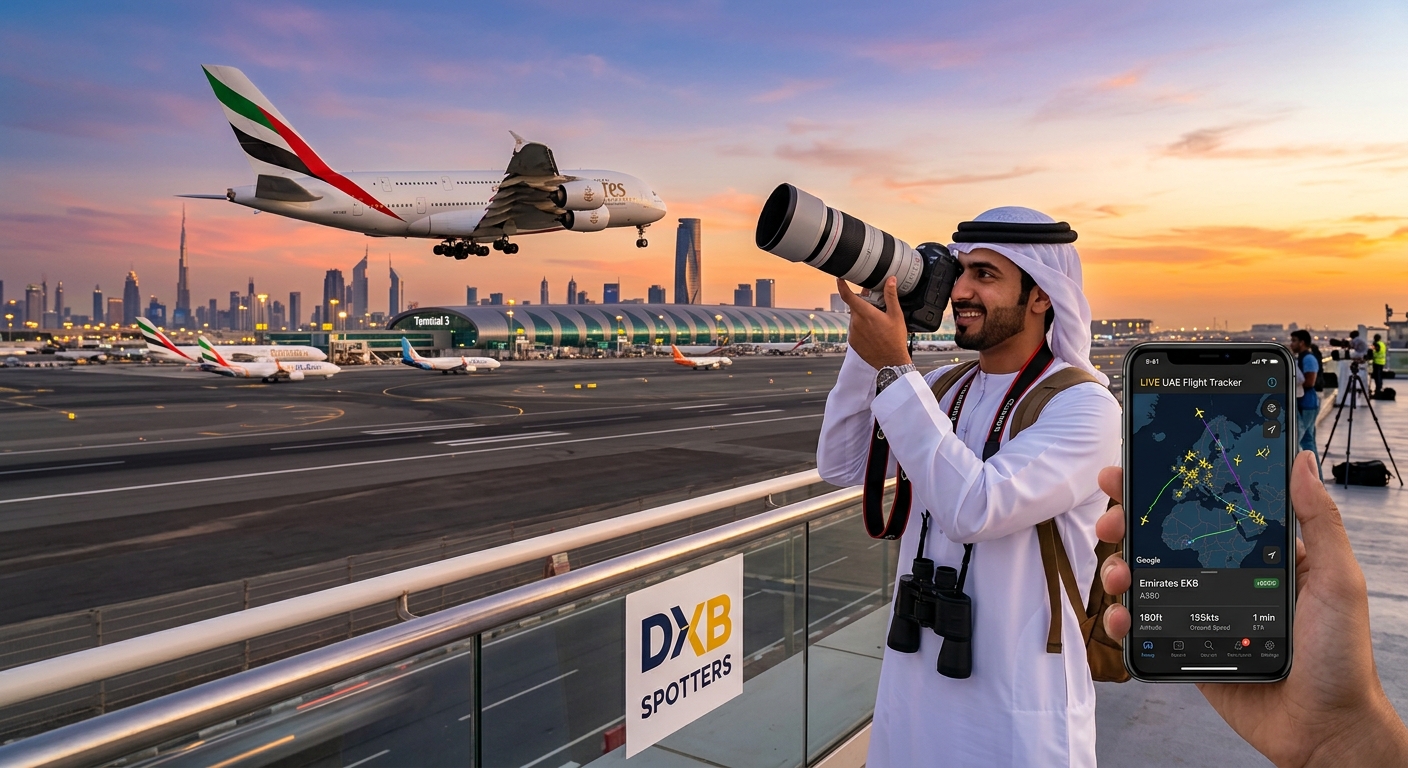
Flight Tracking Apps for UAE Plane Spotters at Dubai Airports
There is something genuinely addictive about watching a widebody climb out of Dubai International at dusk, gear retracting, contrail catching the last of the golden light. If you have ever stood near a DXB perimeter fence and pulled out your phone to figure out exactly what you just saw, you already understand why flight tracking apps have become essential kit for aviation fans across the UAE. The hobby has never been more accessible, and the data available on a basic smartphone now would have impressed a professional dispatcher a decade ago.
Flight tracking apps turn a casual afternoon at Dubai International into a rich, data-driven aviation experience.
- Live ADS-B feeds let you identify any aircraft in real time, down to its exact registration, operator, and route history.
- Apps like Flightradar24, FlightAware, and Plane Finder all cover DXB and DWC traffic comprehensively, with altitude and speed data refreshed every few seconds.
- During the Dubai Airshow, specialist tools help you follow military jets that rarely appear on standard commercial tracking feeds.
Why Dubai Is a Plane Spotter’s Dream Location
Dubai International consistently ranks among the world’s busiest airports for international passenger movements. On any given day, you will see Emirates A380s, Air Arabia A320neos, Ethiopian Cargo 777 freighters, and operators from every continent passing through within minutes of each other. The sheer variety of liveries and aircraft types makes DXB one of the most rewarding spots on the planet for an aviation enthusiast.
Al Maktoum International (DWC) offers a different rhythm. It handles a heavier proportion of cargo movements and general aviation traffic, which means freighter heavies, business jets, and the occasional government aircraft sit on the apron together. Both airports sit in flat, open desert terrain that gives you clear sightlines and predictable approach paths. Light conditions during the golden hours are extraordinary for photography. The heat between May and September is genuinely brutal, though. Most serious spotters head out before 9 AM or wait for evening departures, carrying frozen water bottles and accepting that sunscreen is not optional.
How Flight Tracking Apps Actually Work
Most of the apps you will use rely on ADS-B, which stands for Automatic Dependent Surveillance-Broadcast. Aircraft broadcast their GPS position, altitude, speed, and identification data continuously. Ground-based receivers pick this up and relay it to networked databases, which apps then display on a live map. The technology has been mandated for commercial aviation globally by civil aviation’s primary international standards body, which is why coverage for scheduled airline traffic at a hub like DXB is so comprehensive and reliable.
The UAE has excellent ADS-B receiver density, partly because of the concentration of aviation infrastructure around Dubai and Abu Dhabi. Apps that crowdsource data from volunteer receiver stations tend to perform extremely well here. Position updates at DXB are typically near-real-time, making it easy to watch an aircraft roll onto the runway and follow its climb in the app simultaneously.
The Apps UAE Aviation Fans Actually Rely On
Not every flight tracking app delivers the same experience, and for spotters in the Gulf, a few stand out as worth installing:
- Flightradar24: The most widely used option globally, with dense receiver coverage across the UAE. The live map is fluid, tapping any aircraft pulls up its route, aircraft type, operator, and registration instantly. The paid tier adds history playback, useful for reconstructing what flew during the hours you missed.
- FlightAware: Stronger on airline schedules and delay data, making it useful when you are timing a visit around specific inbound heavies. The flight tracking is solid, though the interface feels more utilitarian compared to Flightradar24.
- Plane Finder: A favourite among enthusiasts for its augmented reality mode. Point your phone at the sky and aircraft silhouettes appear overlaid on the live camera feed, each labelled with callsign, altitude, and aircraft type. At DXB, with multiple arrivals stacked on the ILS, this feature produces a remarkable visual.
- RadarBox: Popular in spotting communities for its detailed data feeds and the ability to filter traffic by aircraft type. If you want to watch only widebody movements or isolate cargo operators, this is the app to reach for.
- Virtual Radar Server: A self-hosted option for enthusiasts who run their own ADS-B receiver at home. More setup involved, but it puts raw data directly under your control and is popular with the technical hobbyist crowd.
Spotting at DXB: Runways, Timing, and Where to Position
Dubai International operates two parallel runways, designated 12L/30R and 12R/30L. The prevailing wind typically pushes early morning departures westward, while afternoon operations can shift. Checking which runway configuration is active before you leave home saves you from arriving at the wrong end of the airport entirely. Both Flightradar24 and RadarBox show active runway usage clearly on their live views.
The Al Rashidiya area on the eastern end provides decent departure shots, while the roads flanking the western perimeter give views of arrivals on runway 30L. Neither is a formal viewing area, so you are using public road access, and that access does change periodically. Always verify current conditions before planning a visit.
At DWC, the distances involved require more preparation. The cargo ramp can host some remarkable visitors when an oversized charter comes through, but finding the right vantage point takes local knowledge. Spotters who have done the reconnaissance tend to keep their spots discreet, for understandable reasons.
Noise Alert Features and Why More Than Enthusiasts Use Them
A significant portion of flight tracking app users in Dubai are residents living beneath the approach paths who simply want to understand the noise above their homes. Flightradar24 and Plane Finder both include overhead notification features that push an alert when an aircraft passes above your GPS location above a set altitude threshold.
This is particularly useful in neighbourhoods along the extended centreline of runway 30L, where arrivals can be low and audible during the pre-dawn hours. Knowing that the 4 AM overhead was an Emirates SkyCargo 777F inbound from Hong Kong is, somehow, more tolerable than being woken by an anonymous roar.
The Dubai Airshow and Following Military Traffic
The Dubai Airshow, held biennially at DWC, is one of the largest aerospace exhibitions on the planet. The flying display typically spans several days and includes military demonstration teams, defence contractor showcases, and prototype aircraft that draw aviation fans from across the region.
Standard commercial tracking apps cover only part of the picture here. Military aircraft frequently operate without standard ADS-B transponders, or they broadcast Mode C squawks only, which limits the data visible on consumer apps. For spotters who want to go beyond what Flightradar24 shows during the display, learning how to track military aircraft opens up a separate layer of tools, including squawk code databases, HF frequency monitoring, and ACARS feeds that capture data standard apps miss entirely.
In the days before the show opens, it is also worth watching standard feeds closely. Ferry flights bringing demonstration aircraft from European and American bases appear on ADS-B as they cross the Gulf, and unusual registrations start appearing on the DWC apron camera feeds. That pre-show window is often when the rarest aircraft are most visible.
Getting More from Your Setup at Dubai’s Airports
A few practical steps make the experience sharper, especially if you are newer to using these tools in the field:
- Pre-configure filters before you arrive. Most apps let you filter by aircraft type, airline, or altitude. Set these up at home so you are not fumbling with menus when something unusual appears on the taxiway.
- Enable alerts for specific registrations. Flightradar24’s paid tier lets you set push notifications when a specific aircraft registration becomes airborne. Useful for tracking a rare delivery flight inbound to Emirates Engineering.
- Cross-reference with LiveATC audio. Listening to Dubai Approach while watching aircraft on a tracking app builds a much richer picture. Hearing a callsign get sequenced, then watching the spacing compress on the map in real time, teaches you how arrivals actually work far faster than reading about it.
- Download offline base maps. Mobile data near DWC’s outer perimeter can drop. Apps that cache tile data locally perform far better in marginal signal areas.
- Learn UTC offsets. Aviation runs on Coordinated Universal Time. Tracking logs, ATC recordings, and app timestamps all use it. Getting comfortable with the four-hour offset from Gulf Standard Time prevents a lot of confusion when cross-referencing data after a session.
The Screen in Your Pocket Already Has You Covered at the Gate
Dedicated radio scanners and purpose-built ADS-B receivers used to be the only way to access this level of information. Now, a phone with Flightradar24 installed and a stable mobile connection delivers the same data to your pocket for a few dirhams a month, or nothing at all on the free tier. The barrier to getting started is genuinely low.
The UAE’s aviation scene is extraordinary by any global measure. Two major international hubs, a biennial airshow that draws hardware from across the aerospace world, and a geographic position at the crossroads of long-haul routes between Europe, Asia, and Africa. Whether you are a lifelong aviation enthusiast or someone who spotted an unfamiliar tailfin on final approach and wanted to know more, the apps above give you a direct way into that world. All you need is a clear sightline, a charged battery, and the patience to wait for the right light.




Post Comment