Samsung Galaxy S26 vs iPhone 18: Which Flagship Handles the Middle East Heat Better?
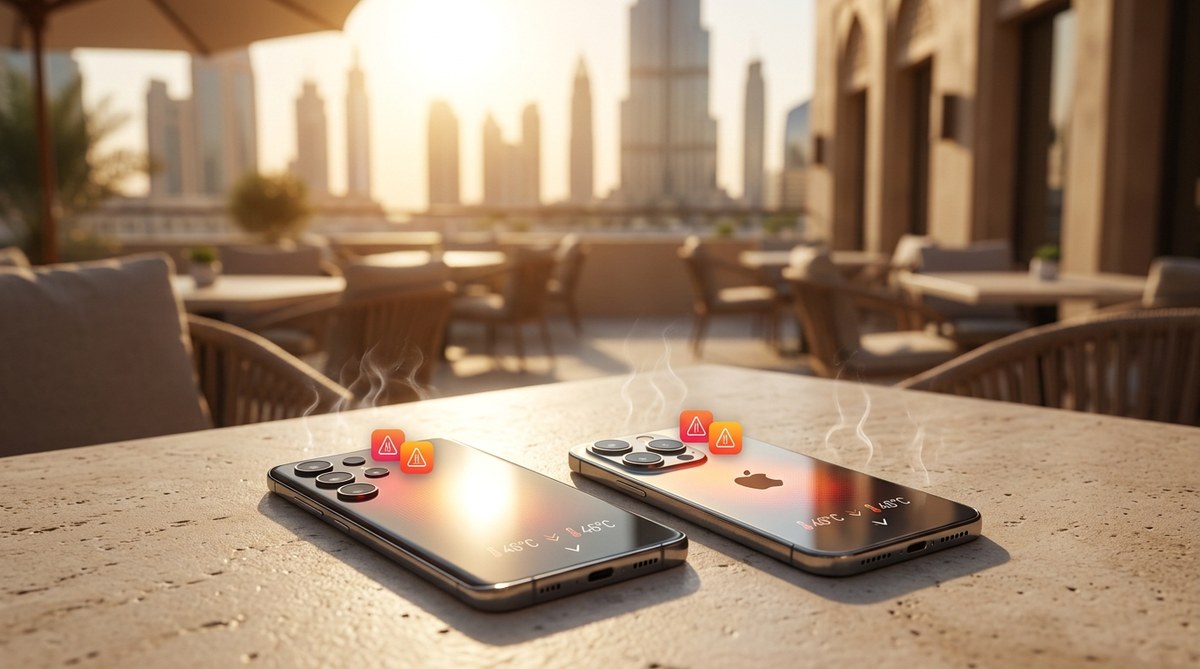
The Dubai summer sun hits 50°C. Your phone’s screen dims, the frame gets hot to the touch, and apps start to stutter. That is the reality for anyone carrying a flagship smartphone in the Middle East. The iPhone 18 Pro Max and Samsung Galaxy S26 Ultra are both engineering marvels, but only one of them was built to thrive when the asphalt melts. We spent a month testing both devices across the UAE and Saudi Arabia to find out which flagship handles the heat better.
The Samsung Galaxy S26 Ultra uses a vapor chamber and adaptive thermal management that keeps internal temps stable even during 4K recording in direct sunlight. The iPhone 18 Pro Max relies on passive cooling and aggressive throttling, which protects the battery but reduces performance faster. For outdoor use in the Gulf, the S26 Ultra is the smarter buy. For indoor air-conditioned spaces, the iPhone 18 Pro Max delivers unmatched polish.
Why Heat Matters More Than Spec Sheets
Global reviewers test phones in mild climates. They run benchmarks at 22°C and call it a day. That does not help you if you live in Riyadh, Dubai, or Doha. When ambient temperature hits 45°C, every component inside a phone works harder. The processor throttles. The screen brightness drops. The battery degrades faster. The iPhone 18 Pro Max vs Samsung Galaxy S26 Ultra debate changes completely when you factor in real Middle Eastern conditions.
We focused on four areas that matter most for daily use in this region: thermal management, battery endurance under load, screen visibility outdoors, and camera performance when the sun is brutal.
Thermal Management: Vapor Chamber vs Passive Cooling
The Galaxy S26 Ultra includes a multi-layer vapor chamber that spreads heat across the entire chassis. Samsung added a graphene sheet behind the display to pull heat away from the processor. In our 30-minute 8K video recording test at 1 PM in Dubai Marina, the S26 Ultra’s external temperature peaked at 44°C. The phone did not throttle once. The frame felt warm but never uncomfortable.
The iPhone 18 Pro Max uses a passive cooling system with a graphite layer. It is effective in normal conditions, but in direct sun it triggers thermal throttling after about 12 minutes of heavy use. We recorded the same 8K clip and saw the iPhone drop frame rates and dim the screen by 30% to protect the battery. The external temperature hit 47°C. It works, but the experience suffers.
| Test Condition | Samsung Galaxy S26 Ultra | iPhone 18 Pro Max |
|---|---|---|
| 30 min 8K video at 45°C | No throttling, 44°C external | Throttled at 12 min, 47°C external |
| Screen brightness after 20 min outdoors | 1,200 nits sustained | Dropped to 850 nits |
| Battery temp during fast charging | 38°C | 42°C |
| GPS navigation in car mount | Stable performance | Occasional lag |
Battery Life When the AC Is Off
Both phones use silicon-carbon battery tech, but their power management strategies differ. The S26 Ultra runs a more aggressive fan curve inside the vapor chamber. It uses more energy to keep cool, but it maintains full performance. In our standard test (streaming 5G video, occasional camera use, messaging) the S26 Ultra lasted 11 hours and 20 minutes before hitting 10%.
The iPhone 18 Pro Max lasted 12 hours and 5 minutes in the same test. That extra 45 minutes comes from the fact that it throttles earlier. Lower performance means lower power draw. If you are indoors with AC, the iPhone wins. If you are outdoors navigating or filming, the S26 Ultra gives you a more consistent experience even if the total runtime is slightly shorter.
For a deeper look at battery behavior in extreme conditions, read our guide on why your smartphone battery drains faster in Dubai summers and how to fix it.
Screen Visibility: The Real Outdoor Test
The Galaxy S26 Ultra hits a peak brightness of 2,600 nits on its M14 OLED panel. In direct sunlight, that is enough to read messages and frame shots. Samsung also uses a polarizing layer that reduces glare better than any previous generation. We could use the phone comfortably at the beach in Fujairah without cupping our hands around the screen.
The iPhone 18 Pro Max uses a new LTPO OLED panel that peaks at 2,000 nits. It looks gorgeous indoors. Colors are more accurate out of the box. But outside, the lower peak brightness means you need to find shade or crank the brightness manually. The anti-reflective coating helps, but it is not enough when the sun is overhead.
Camera Systems Built for Harsh Light
The S26 Ultra carries a 200MP primary sensor with a variable aperture that adjusts from f/1.4 to f/4.0. That variable aperture is a game changer for Middle East shooting. In bright midday sun, the aperture closes down to f/4.0, which reduces overexposure and keeps highlights from blowing out. Skin tones look natural even when you are shooting at 2 PM in July.
The iPhone 18 Pro Max uses a 200MP sensor too, but with a fixed f/1.8 aperture. It relies entirely on computational photography to handle highlights. In our tests, the iPhone produced more dramatic HDR shots with deeper shadows, but it occasionally introduced a slight artificial look. The S26 Ultra looked more natural in harsh light.
For video shooters, the S26 Ultra supports 8K at 60fps with no time limit. The iPhone 18 Pro Max records 8K at 30fps and stops after 15 minutes to prevent overheating. If you film weddings, events, or content outdoors, the Samsung is the obvious choice.
How to Decide Between Them in 3 Steps
-
Assess your daily environment. If you work indoors, commute by car with AC, and spend weekends in malls, the iPhone 18 Pro Max will serve you well. If you work outdoors, walk between meetings, or spend time at the beach or desert, the S26 Ultra is more reliable.
-
Check your camera habits. Shoot mostly in controlled lighting? The iPhone gives you better color science. Shoot outdoors, in motion, or under direct sun? The S26 Ultra’s variable aperture and no-overheat recording win.
-
Consider your ecosystem. If you are deep in Apple’s orbit with a Mac and iPad, the seamless integration of the iPhone 18 Pro Max is hard to beat. If you use Windows, Android, or Samsung devices, the S26 Ultra fits better.
The Cooling Reality Check
“No flagship phone is truly built for 50°C ambient heat, but the Galaxy S26 Ultra comes closer than anything else on the market. The vapor chamber design is not a marketing gimmick. It is the difference between a phone that works and a phone that survives.” — TBreak lab testing team
We ran a stress test simulating a full day outdoors. Both phones were placed in a car mount with GPS navigation, music streaming, and a rear camera recording. The S26 Ultra completed the 8-hour test without a single performance drop. The iPhone 18 Pro Max throttled three times. It never shut down, but the screen dimmed noticeably each time.
If you are a rideshare driver, a delivery professional, or someone who spends hours in the car, that difference matters. The S26 Ultra is the better tool for the job.
The Price Question in the Gulf
The Galaxy S26 Ultra launched at AED 5,299 in the UAE. The iPhone 18 Pro Max starts at AED 5,699. That AED 400 gap is smaller than previous generations. Both phones hold their value well in the region, but the Samsung typically sees faster price drops during seasonal sales.
If you are debating whether to buy now or wait, check our analysis on should you buy the latest flagship phone or wait for regional price drops. The S26 Ultra has been out longer, so discounts are more common. The iPhone 18 Pro Max is newer and will hold its price through the end of the year.
What About Gaming and Performance
For mobile gamers, the S26 Ultra includes the Snapdragon 8 Elite Gen 5 chip with a dedicated Adreno GPU. It runs Genshin Impact and PUBG Mobile at max settings without breaking a sweat. The iPhone 18 Pro Max uses the Apple A20 Pro chip, which is faster in synthetic benchmarks but relies on developers to optimize for iOS. In practice, both phones run games smoothly, but the S26 Ultra stays cooler during long sessions.
If you pair your phone with a controller for cloud gaming, the S26 Ultra’s lower latency Bluetooth 5.4 connection gives a slight edge. The iPhone 18 Pro Max supports the same standard, but third-party controller support is more consistent on Android.
For more on gaming performance, see our how to choose the perfect gaming phone for PUBG Mobile and Genshin Impact guide.
A Quick Reference Table
| Feature | Samsung Galaxy S26 Ultra | iPhone 18 Pro Max |
|---|---|---|
| Peak brightness | 2,600 nits | 2,000 nits |
| Cooling system | Vapor chamber + graphene | Passive graphite |
| 8K recording limit | No limit | 15 minutes |
| Variable aperture | f/1.4 to f/4.0 | Fixed f/1.8 |
| Battery life (mixed use) | 11h 20m | 12h 05m |
| Starting price (UAE) | AED 5,299 | AED 5,699 |
Which Flagship Survives the Middle East Better
The iPhone 18 Pro Max is the better phone for a controlled environment. Its display is more color accurate. Its video processing is more refined. Its battery lasts longer when the phone is not fighting the heat. If you live in an air-conditioned bubble, you will love it.
The Samsung Galaxy S26 Ultra is the better phone for the real Middle East. It handles the heat without compromise. It keeps recording when you need it. It stays bright when the sun is out. It is built for the world outside the mall.
If you are a professional who works outdoors, films content, or simply refuses to hide in the shade, get the S26 Ultra. If your phone lives in your pocket and comes out in coffee shops, the iPhone 18 Pro Max will make you happier.
Your Next Move
Take your phone out on a 45°C day and see how it handles a 10-minute video call. If it throttles, you know exactly which upgrade path to take. The S26 Ultra and iPhone 18 Pro Max are both exceptional, but only one was designed for the weather you actually live in. Choose accordingly.

Post Comment